Edward Conard

Top Ten New York Times Bestselling Author

  • “…reminds us that inequality sends a signal of what society lacks most, in America’s case, entrepreneurship and risk taking.” - Lawrence Lindsey, CEO, The Lindsey Group, former Director of the National Economic Council
  • “A full-throated defense of economic dynamism.” - The Wall Street Journal
  • “Unintended Consequences provides a provocative interpretation of the causes of the global financial crisis and the policies needed to return to rapid growth. Whether you agree or not, this analysis is well worth reading.” - Nouriel Roubini, New York University; Chairman, Roubini Global Economics
  • “…a comprehensive explanation of the modern economy.” - Julian Robertson, Founder, Tiger Management
  • “…serious thinking for serious thinkers. …a thought-provoking blueprint for growing middle- and working-class incomes.” - Mitt Romney, former Governor of Massachusetts
  • “…challenges misconceptions that distort our economic debates.” - Arthur Brooks, President of the American Enterprise Institute
  • “…a fresh argument for the productive value of inequality.” - David Autor, Professor of Economics, Massachusetts Institute of Technology
  • “There are an amazing number of good ideas and interesting points made in Unintended Consequences. The thinking underlying it, and the obvious depth of understanding of the author, are very impressive.” - Steven Levitt, coauthor of Freakonomics; 2004 John Bates Clark Medal
  • “Unintended Consequences is far smarter and more thought-provoking than most economics written for the general public” - Greg Mankiw, Harvard University, Former Chairman of the Council of Economic Advisors
  • “…a fresh argument for the productive value of inequality.” - David Autor, Professor of Economics, Massachusetts Institute of Technology
  • “…challenges misconceptions that distort our economic debates.” - Arthur Brooks, President of the American Enterprise Institute
  • “…a must-read for serious students of economic policy.” - Glenn Hubbard, Dean, Columbia Business School, and former Chairman of the Council of Economic Advisers
Upside of Inequality Oxford Unintended Consequences
Buy the Books
  • Macro Roundup
  • About Roundup
  • About Ed Conard
  • Highlights
  • Topics
  • Subscribe
Edward Conard
  • twitter
  • facebook
  • linkedin
  • youtube
  • Email
  • Text Message (SMS)
  • Twitter/X
  • LinkedIn
  • Facebook
  • WhatsApp Message
Subscribe to Macro Roundup Emails
  • Mentions 594
  • Primary focus 100
For whatever topics you select (currently: Historical):
Choose search scope

Your importance filter 'Database' shows fewer articles.

Remove filters to see full article counts

Americas Hidden Workforce Returns

AI Summary. The share of US disability claims approved fell to 48% from 62% in 2001, and the number of Americans receiving federal disability benefits declined to 8.5m from a peak of 9m. With unemployment at 3.9%, employers widened candidate searches, and the disability trust fund's projected depletion moved to 2032.

Eric Morath Wall Street Journal
Date Posted:
January 26, 2019
Is Database:
Database

The share of disability claims allowed fell to 48% in 2016, down from 62% in 2001, marking the first time the rate dropped below 50% since 1992.

Are fewer disability approvals and tight labor markets boosting employment?

Core argument: The share of U.S. disability claims allowed fell to 48% in 2016 from 62% in 2001, the first time the approval rate dropped below 50% since 1992.

The share of disability claims allowed fell to 48% in 2016, down from 62% in 2001, marking the first time the rate dropped below 50% since 1992. This decline in approvals has led many to seek employment instead of applying for benefits. As a result, the number of Americans receiving federal disability benefits decreased to 8.5m in December from a peak of 9m four years earlier. The tight labor market, with a low unemployment rate of 3.9% in December, has prompted employers to expand their candidate search, benefiting disabled workers. In 2017, 51,302 people left disability for gainful employment, the highest on record since 2002. This shift is stabilizing the Social Security program, with the disability trust fund's projected depletion extended to 2032 due to lower application rates. The trend reflects a broader economic opportunity for disabled Americans as they re-enter the workforce, contributing to economic growth and reducing reliance on government support.
Takeaways by Macro Roundup® AI

  1. The share of U.S. disability claims allowed fell to 48% in 2016 from 62% in 2001, the first time the approval rate dropped below 50% since 1992.
  2. Americans receiving federal disability benefits fell to 8.5m in December from a peak of 9m four years earlier, and 51,302 people left disability for gainful employment in 2017, the highest since 2002.
  3. Lower disability application rates extended the projected depletion of the Social Security disability trust fund to 2032, while a tight labor market and 3.9% December unemployment prompted employers to widen their candidate search.

“…The share of applying workers whose disability claims were allowed following a medical review in 2016 fell to 48.0%, according to the latest available data from Social Security. That was the first time the rate was below 50% on records dating to 1992. Allowances peaked at 62% in 2001. “A smaller share of people are getting on the program, and that is causing people to not apply and instead to seek alternatives,” said David Autor, an economist at the Massachusetts Institute of Technology. His research was among the first to document the causes and consequences of rising disability claims. Mr. Autor said the recent decrease in disability applications and awards is similar to a crackdown in the early 1980s, which Congress later reversed, setting off a long march higher in claimants….”

Americas Hidden Workforce Returns: Extended Excerpt Image 1

Eric Morath, "America’s Hidden Workforce Returns,"Wall Street Journal, January 26, 2019, https://www.wsj.com/articles/americas-hidden-workforce-returns-11548478801

America’s Hidden Workforce Returns

WYOMING, Mich.—Like many adults with disabilities, Nathan Mort has often struggled to find and hold a job. A conservation group once declined his attempt to volunteer. The 37-year-old West Michigan native, who has a high-functioning form of autism, ended up living with his parents and dependent on government payments.

His fortunes turned several years ago when a local food distributor, Gordon Food Service, found itself short of entry-level workers and developed an internship program for adults with disabilities. Mr. Mort was hired from the program permanently to track warranty claims for the company’s trucks and other equipment. That allowed him to stop collecting federal disability benefits and move into his own home.

“A reason why I like my job is because it’s kind of the same thing over and over again. I really like routines. That is part of my autism,” Mr. Mort said. Making his own money, he added, “makes you feel more worth something.”

Mr. Mort is part of a wave of disabled Americans joining or returning to the U.S. labor force, breaking a long-running trend that had pushed millions to the sidelines of work. These workers have benefited from a tight economy with a very low overall unemployment rate—3.9% in December, just above lowest level since 1969—as employers in many sectors tackle a shortage of available workers by becoming more creative about whom they recruit.

Americas Hidden Workforce Returns: Extended Excerpt Image 2


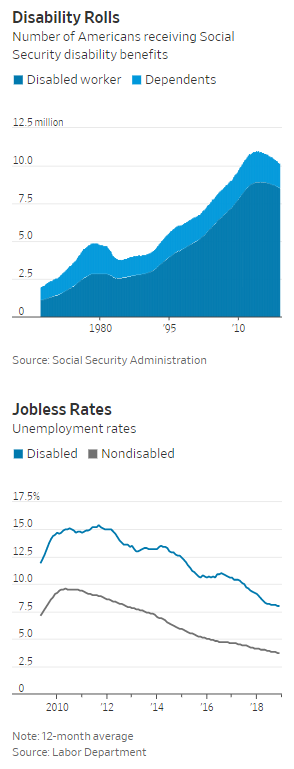
The number of American workers receiving federal disability benefits dropped to 8.5 million in December from a peak of 9 million four years earlier as the share of disabled Americans in the labor force rises. The average monthly jobless rate for the disabled in 2018 was 8%, down 4.6 percentage points from 2014. Unemployment for this group is falling at a faster rate than for the broader population.

“This is really quite a dramatic turnaround,” said Nicole Maestas, an economist at Harvard Medical School who studies the disability system. “Employment among people with disabilities had been declining for a really long time—now it’s not. And it’s not transitory. It’s been increasing for a few years.”

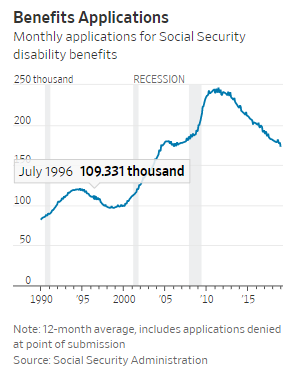
Two factors are at play. First, the tight labor market is causing employers like Gordon Food Service to expand their search for job candidates. Second, Social Security disability benefits—which for many became a de facto second form of unemployment insurance after the last recession ended in 2009—have become harder to access.

When the disability-benefits system found itself on shaky financial footing a few years ago as its rolls swelled, the Social Security Administration pushed new training guidelines to administrative judges who decide which claims will be granted, with the aim of producing more consistent rulings. Before those efforts, judges in some states approved claims at unusually high rates. Members of Congress from both parties in 2011 called for an investigation into the way administrative judges determine whether an applicant qualifies for disability benefits and federal prosecutors began probing the practices of specific judges.

Americas Hidden Workforce Returns: Extended Excerpt Image 3


The share of applying workers whose disability claims were allowed following a medical review in 2016 fell to 48.0%, according to the latest available data from Social Security. That was the first time the rate was below 50% on records dating to 1992. Allowances peaked at 62% in 2001.

“A smaller share of people are getting on the program, and that is causing people to not apply and instead to seek alternatives,” said David Autor, an economist at the Massachusetts Institute of Technology. His research was among the first to document the causes and consequences of rising disability claims.

Mr. Autor said the recent decrease in disability applications and awards is similar to a crackdown in the early 1980s, which Congress later reversed, setting off a long march higher in claimants.

Before Gordon Food Service hired him in 2014, Mr. Mort spent a decade without regular work, despite earning a degree from Grand Valley State University near his home. He was let go from a part-time mail-clerk job in college because pain in his hands, a side effect of his condition, made him slow sorting envelopes. He quit another job packing croutons at a food-processing plant after a day. The pace was too fast. He was laid off from another job sorting and hanging clothes at a Salvation Army resale shop. The job presented him with too many distractions. “I probably did not work fast enough,” Mr. Mort said.

The program that brought Mr. Mort to Gordon Food Service came from the company recognizing it may be missing a potential pool of candidates, said Jill Day, senior talent acquisition leader. A suggestion to work with Hope Network, a Grand Rapids, Mich., nonprofit that serves the disabled, came from staff members who had disabled family members.

“For many of our entry-level positions, there’s not enough people going into those roles,” she said. “I think that creates a great opportunity for the company to step back and ask ‘What can we be doing differently?’ There’s an enormous number of people with disabilities who are hungry to work and want to contribute.”

Gordon Food Service was able to tap into what some autism experts call a “splinter skill,” something an autistic person does exceptionally well. For Mr. Mort it’s the ability to process complex strings of numbers combined with being a fast typist—his hands don’t bother him on a keyboard.

As vehicle-warranty administrator, Mr. Mort spends his time copying serial numbers, submitting warranty repair orders, tracking claims, and managing databases. After his internship he was hired for a part-time job. He gradually increased his hours and in November was given a full-time role, taking home more than $400 a week plus health benefits.

“He has incredible focus and never seems to get tired of processing claims,” said Jason Derby, Mr. Mort’s supervisor and Gordon Food Service fleet-maintenance manager.

Mr. Mort uses his earnings to pay for maintenance and property taxes on a two-bedroom condo his parents purchased for him last year. He also enjoys reading fantasy books by J.R.R. Tolkien and Brandon Sanderson, playing “Warcraft” videogames, visiting area zoos and attending Civil War re-enactments.

Mr. Mort’s father, Bruce, now worries less about what will happen once he and his wife are no longer able to care for their son. “It was scary for a while,” he said. “During the recession there weren’t many companies willing to give someone with autism a chance.”

Most people exit the Social Security disability system because they either qualify for retirement benefits or die. Disability pays roughly the equivalent of working full time at the federal minimum wage, $7.25 an hour. Unlike many low-wage jobs, it comes with health insurance, Medicaid, and is adjusted for the cost of living.

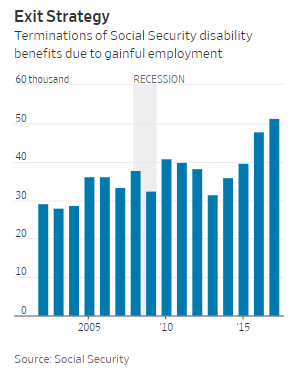
But people like Mr. Mort are no longer a rarity. In 2017, according to the latest data available, 51,302 people left disability because they found “gainful” employment. That is the most on records dating to 2002 and nearly 30% higher than in 2011.

Americas Hidden Workforce Returns: Extended Excerpt Image 4


Disabled workers finding jobs is putting the Social Security program on firmer ground. In 2015, the disability trust fund was nearing exhaustion. Congress ordered that a greater share of federal payroll tax revenue temporarily go to the trust fund to bolster it.

Last year, Social Security Chief Actuary Stephen Goss told members of Congress that the projected depletion of the disability trust fund was extended by four years to 2032, a shift “based primarily on continuing lower-than-expected disability application and incidence rates.”

The tighter labor market is delivering opportunities to a broad swath of workers who were disproportionately affected by the last recession. Unemployment has fallen sharply for blacks, Latinos, younger workers and those without a college education.

But the deeper jobs pool has been particularly crucial for improving the economic outlook of the disabled Americans who have been denied benefits at a higher rate in recent years. Take Keri Dougherty, of Paris, Tenn., a 23-year-old with autism who qualified for Social Security payments as a child but was denied when she applied for disability benefits as an adult. Her family didn’t appeal the decision made in 2013. “We didn’t have the money to fight it,” said Laura Dougherty, Keri Dougherty’s aunt, who raised her since she was 5. “But that’s OK, we had bigger aspirations for Keri anyhow.”

Keri Dougherty, whose disability prevents her from driving, completed high school and two years ago received employment training at the Tennessee Rehabilitation Center in Smyrna, Tenn. Days after finishing her training at the center, she attended a job fair and was soon hired to work at a trailer that collects donated items for the Goodwill Industries charity.

The job allowed her to move into her own apartment in December and to buy an old car, even though she’s unable to drive it. She leaves it parked near the unheated trailer so she can warm up during breaks. She earns about $9 an hour and works 40 hours a week. “I’ve wanted to live independently for a long time,” Ms. Dougherty said. “I wanted to experience how the real world works.”

Patty Kasbohm, director of operations at Hope Network, who helped place Mr. Mort in his job, said the tougher rules around disability programs are causing hardship for some, including less access to job-training programs that come with the benefits. She said people with some forms of autism are particularly challenged because they have high IQs, which can disqualify them for benefits, but their social skills often prevent them from finding work on their own.

Another factor removing pressure on the Social Security disability program is demographics. When the recession hit in 2007, the baby boomers were in their 50s and early 60s. Older workers are more likely to have impediments, including vision challenges and pain, that may qualify them for disability. Now baby boomers are increasingly eligible for Social Security retirement, shifting the payment burden to that program.

Americas Hidden Workforce Returns: Extended Excerpt Image 5


And some older workers are returning to jobs after a stint on benefits.

A onetime construction worker, Elton Crouse went on disability in 2002 after he fell 16½-feet down an elevator shaft in Michigan. “The fall was a breeze,” he said. “It was the sudden stop that got me.” The injury has left his neck too weak for physical jobs.

After five years on disability benefits, Mr. Crouse was told by a counselor assisting in his rehabilitation that because he had improved he needed to pursue part-time work or risk losing payments.

Mr. Crouse, now 59, for years bounced between jobs but in 2017 he landed what he considers the perfect role: greeting customers at Duluth Trading Co. clothing store, among other tasks. The company has been accommodative of his disability, reassigning him to mop floors before store openings when short-term memory loss associated with his accident made operating the cash register too difficult.

“They’re really willing to jump through hoops for me,” he said.

Mr. Crouse hopes to work for the store until he can tap old-age Social Security benefits in a few years. By working part-time, but remaining eligible for benefits under a Social Security program known as Ticket to Work, Mr. Crouse earns between $800 and $1,000 more a month than he would otherwise, which helps offset rising prescription drug costs.

In some cases, Americans with disabilities are creating their own jobs. People with disabilities are more likely to be self-employed than the nondisabled, according to the Labor Department.

Mark Burke, who is deaf, found it hard to find new employment in 2014, after he was let go from his job as athletic director at Model Secondary School for the Deaf in Washington, D.C. One constraint was that he didn’t want to move his family, including his in-laws and young daughter, from their suburban Maryland home.

“Emotionally, it was very tough,” he said, speaking through a signing interpreter. “What can I do? Where can I go?” He said he applied for about 300 federal government jobs. He received two callbacks and no job offers.

After a year out of work—when he received Social Security disability benefits—Mr. Burke, now 48, took a job tending bar. The bar that hired the devoted home brewer is located near Gallaudet University, a federally chartered school for the deaf in Washington. Mr. Burke’s ability to sign and deep knowledge of craft beer helped land him the job, where he also waited on hearing customers.

That led Mr. Burke to think he could open a microbrewery. He pitched his idea at a Gallaudet entrepreneurship competition in the style of the television show “Shark Tank.” He didn’t win, but the experience gave him and his co-owners, friends and fellow Gallaudet alumni, the confidence to open Streetcar 82 Brewing Co. in Hyattsville, Md., in September.

Ryan Maliszewski, director of the Gallaudet Innovation & Entrepreneurship Institute, said technology, including lower-cost video interpreting, has opened doors for deaf people to start businesses and take jobs ranging from app developers to accountants, where they can work remotely.

“I’d always dreamed of owning my own business, but when I graduated from college I didn’t think the opportunity existed,” Mr. Burke said, sitting on a barstool across the room from a silver fermenter, where he recently finished brewing a coffee stout. He added that in the 1990s, deaf people were pushed toward jobs in the government or large corporations that were more able to afford accommodations, such as interpreters.

Now Mr. Burke said he regularly uses email, texting and social media to communicate with vendors and other business associates. “A lot of them don’t realize that I’m deaf until we meet face-to-face,” he said. “Back in the day I don’t think people would want to deal with that—but now I think it’s OK.”

  • Historical
  • Comparisons
    • Other Comparison
  • Workforce
    • Poverty/Crime
    • Unemployment/Participation
Previous articleJanuary 22, 2019Straight Up Conversation: RAND Education Chief Darleen OpferRAND Education Chief Darleen Opfer Gate’s Education Initiative “Didn’t Make An Impact”.Next articleJanuary 26, 2019U.S. Income More Equal than AdvertisedCritics of Piketty & Saez highlight errors in their methodology, such as excluding gov’t transfer payments from national income calculations. Adjusted figures reveal a much flatter curve in income distribution.
Showing 100 database articles primarily about Historical
Currently filtering by:
  • Remove 'Database'

The Impacts of Covid-19 Illnesses on Workers

AI Summary. The authors estimate that Covid-19 illnesses reduced the U.S. labor force by about 500,000 workers, as weekly health-related absences rose from six to ten per thousand workers and those missing a week were 7% less likely to remain in the labor force a year later. They put the cost at roughly $9,000 in forgone earnings per absence, or $62bn annually.

Evan Soltas National Bureau of Economic Research
Date Posted:
September 15, 2022
Is Database:
Database

Covid-19 illnesses have reduced the US labor force by ~500,000 workers by June 2022, with an annual loss of $62bn in forgone earnings.

How much have pandemic illnesses shrunk the U.S. labor force?

Core argument: Covid-19 illnesses reduced the U.S. labor force by roughly 500,000 workers by June 2022, attributed to health-related absences rising from six to ten per thousand workers weekly during the pandemic.

Covid-19 illnesses have significantly impacted the U.S. labor force, reducing it by approximately 500,000 workers by June 2022. This reduction is attributed to a persistent increase in health-related absences, which rose from six to ten per thousand workers weekly during the pandemic. These absences correlate with reported Covid-19 cases and are more prevalent in high-exposure occupations. Workers missing a week due to Covid-19 are 7% less likely to remain in the labor force a year later, contributing to a 0.2 percentage point drop in the labor force participation rate. The economic cost of these absences is substantial, with an average loss of $9,000 in forgone earnings per absence, totaling an annual loss of $62bn. This impact is comparable to an additional year of U.S. population aging, highlighting the significant macroeconomic implications of Covid-19 on labor supply.

Takeaways by Macro Roundup® AI

  1. Covid-19 illnesses reduced the U.S. labor force by roughly 500,000 workers by June 2022, attributed to health-related absences rising from six to ten per thousand workers weekly during the pandemic.
  2. Workers missing a week of work due to Covid-19 are 7% less likely to remain in the labor force a year later, contributing to a 0.2 percentage point drop in the labor force participation rate.
  3. Covid-19 absences cost an average $9,000 in forgone earnings per absence, totaling $62bn annually, an impact comparable to an additional year of U.S. population aging.

“…This paper studies the impacts of Covid-19 illnesses on the labor supply of U.S. workers using longitudinal data from the Current Population Survey (CPS). We first document that the rate of week-long health-related absences has been substantially elevated during the pandemic relative to pre-pandemic seasonal patterns, and that these excess absences appear to reflect Covid-19 illnesses. In a typical pandemic week, about ten workers per thousand missed an entire week of work due to their own health problems, as compared to six health-related absences per thousand workers in an average week from 2010 to 2019.Excess absences covary with reported Covid-19 cases both in the national time-series and a state panel, and are higher among occupations with higher Covid-19 exposure. Second, we show that health-related absences generate persistent reductions in labor supply. Using an event study, we find that workers who miss an entire week due to probable Covid-19 illnesses are approximately 7 percentage points less likely to be in the labor force one year after their absence compared to otherwise-similar workers who do not miss work for health reasons. These estimates appear representative for Covid-19 illnesses specifically, not only as an average over myriad health issues, and they are about the same as the average effects of pre-pandemic health-related absences. One reason why Covid-19 illnesses reduce labor supply is that they push older workers into retirement. Our results are thus best interpreted as identifying not “long Covid” in isolation but rather the overall labor-supply adjustment, across mechanisms, induced by Covid- 19 illnesses. We next use our results to assess the aggregate impacts of Covid-19 illnesses on the U.S. labor force participation rate. Combining our event-study results with the excess rate of health-related absences, we estimate that Covid-19 illnesses have reduced the labor force participation rate by 0.2 percentage points, or by approximately 500,000 workers, through June 2022. This point-in- time impact is near our estimates of the steady-state impact of Covid-19 illnesses at the average rate of health-related absences in 2021. These losses fundamentally reflect an overall increase in the health-related absence rate with no change in the average long-run impact of an absence. We also discuss additional considerations that would increase or reduce the total effect of Covid-19 illnesses on labor supply relative to our preferred estimate. Overall, the loss in U.S. labor supply from Covid-19 illnesses appears substantial, comparable to an additional year of U.S. population aging at its current pace.Finally, we calculate the average cost of a Covid-19 absence in forgone labor earnings through fourteen months after the absence, including both extensive and intensive margins of adjustment. The average Covid-19 absence results in forgone earnings of at least $9,000, about 90 percent of which is due to persistent labor-supply reduction beyond the week-long absence itself. This economic cost can be viewed as a revealed-preference measure of the medium-term health impact of Covid-19 illnesses. In aggregate, we calculate that the per-year value of the lost labor supply is approximately $62 billion, which is about half of estimated losses from cancer or diabetes….”

Evidence of Covid Impact on LFP

“…We find that Covid-19 illnesses have likely become, over the last two years, an important contributor to the net change in the participation rate. By June 2022, Covid-19 illnesses reduced the participation rate by 0.18 percentage points, with a range of 0.13 to 0.22 percentage points, as we show in Appendix Figure A21. These reductions in the participation rate imply that approximately 500,000 adults are neither working nor actively looking for work due to the persistent effects of Covid-19 illnesses, with a range of 340,000 to 590,000 adults. This point-in-time participation-rate loss is near the steady-state loss associated with the 2021-average rate of health-related absences. That is, if the health-related absence rate remains near its 2021 level, and if the impacts of Covid- 19 absences are unchanged, then our estimates suggest the participation rate will be persistently reduced by approximately 0.2 percentage points….”

Gopi Shah Goda and Evan Soltas, "The Impacts of Covid-19 Illnesses on Workers,"National Bureau Of Economic Research, September 2022, https://www.nber.org/papers/w30435

  • Historical
  • Workforce
    • Unemployment/Participation

The 55-and-Older Labor Market Exodus Is a Statistical Mirage

AI Summary. Labor force participation among prime-age men aged 25–54 has declined substantially since the 1970s; restoring it to 1970 levels would add about 4.5m workers to the US labor force. Returning the participation rate for men aged 55–64 to its August 1970 level of 82.6% would add roughly 2m workers.

Justin Fox Bloomberg
Date Posted:
September 15, 2022
Is Database:
Database

Restoring prime-age male labor force participation to 1970 levels would add 4.5mm workers to the US labor force, according to @JustinFox at @Bloomberg.

How many workers would restoring men's earlier participation rates add?

Core argument: Restoring labor force participation among prime-age men aged 25–54 to 1970 levels would add about 4.5m workers to the US labor force.

Despite perceptions of a labor market exodus among older Americans, the real issue lies with prime-age male labor force participation, which has significantly declined since the 1970s. While the labor force participation rate for men aged 55-64 is below mid-1970s levels, returning it to the August 1970 rate of 82.6% could add 2m workers. More crucially, restoring the participation rate for prime-age men (25-54) to 1970 levels would introduce an additional 4.5m workers into the US labor force. Addressing this decline could be pivotal in bolstering the American workforce, as reversing these long-term trends presents a significant challenge but also a potential opportunity for economic growth.

Takeaways by Macro Roundup® AI

  1. Restoring labor force participation among prime-age men aged 25–54 to 1970 levels would add about 4.5m workers to the US labor force.
  2. Returning the participation rate for men aged 55–64 to the August 1970 rate of 82.6% would add about 2m workers, as that group's rate remains below mid-1970s levels.
  3. The decline in prime-age male labor force participation since the 1970s, rather than an exodus of Americans aged 55 and older, is the central US workforce problem.

“…Then again, there is another composition effect at work in these statistics that I haven’t discussed. While women’s labor-force participation rates rose from the 1950s through 1990s, men’s fell. So while the current labor-force participation rate for all Americans in their late 50s and early 60s is near an all-time high, for men it’s well below the rates that prevailed before the mid-1970sThe puzzle of why labor-force participation fell so much among US men of all ages was a major topic of economic discussion in the 2010s that’s probably due for a revival. For those in their late 50s and early 60s the decline wasn’t all bad news, as generous early retirement packages surely drove some of it. Those are less common than they used to be, whileboosting male 55-64 labor force participation back to, say, the August 1970 rate of 82.6% would add 2 million would-be workers to the US job market. Bringing the participation rate for so-called prime-age men (25-54) back to 1970 levels would add another 4.5 million.Reversing changes that happened half a century ago is surely a lot harder than reversing those of the past couple of years. But maybe it’s the next frontier….”

Justin Fox, "The 55-and-Older Labor Market Exodus Is a Statistical Mirage,"Bloomberg, September 9, 2022, https://www.bloomberg.com/opinion/articles/2022-09-09/americans-older-than-55-haven-t-given-up-working

The 55-and-Older Labor Market Exodus Is a Statistical Mirage

I’m in my late 50s and I’m on the job. So are more than 70% of Americans aged 55 through 59, according to the Bureau of Labor Statistics. In fact, my age group’s labor-force participation rate was approaching record levels earlier this year before undergoing its usual summer decline.

The 55-and-Older Labor Market Exodus Is a Statistical Mirage: Extended Excerpt Image 1


As a result, I tend to bristle a little whenever I read about the big drop in labor-force participation among Americans 55 and older and its supposed adverse effects on the labor market and the economy. It is true that, as of August, the labor-force participation rate for the entire 55-plus age group was, at a seasonally adjusted 38.6%, down 1.7 percentage points from just before the pandemic in February 2020 and near its lowest level in 15 years. But as I’ve already demonstrated, those of us in our late 50s aren’t the problem. We’re still working at record rates!

Americans in their early 60s are pretty close to record labor-force participation, too. The big declines are all among those 65 and older. But — and here’s where things get really weird — those declines are still smaller in percentage-point terms than those for the 55-and-older group overall. This strange data quirk is the result of so-called composition effects, caused by the shifting age distribution within the age group, which I’ll discuss a little later. First, though, let’s get around the strange quirk by looking at labor market changes for smaller age groups.

The reason the 55-and-older numbers get so much attention is that it’s the one of the few age groups for which the BLS provides seasonally adjusted labor market data. The unadjusted numbers come with big seasonal swings and, especially when you’re looking at narrow age groups such as 55 through 59, a fair amount of month-to-month statistical noise. Still, there are ways to deal with both, such as comparing three-month averages from this summer with those from before the pandemic in 2019.

The 55-and-Older Labor Market Exodus Is a Statistical Mirage: Extended Excerpt Image 2


The labor-force participation rate is the estimated number of Americans who have paid jobs (not counting active-duty military) or are looking for work, divided by the civilian, non-institutionalized working-age population. Another key metric, the employment-population ratio, is those with paid jobs divided by population, also excluding active-duty military and the institutionalized. Both are expressed as percentages, so why one is called a rate and the other a ratio is a mystery to me. After this chart I’ll just refer to both as rates.

The 55-and-Older Labor Market Exodus Is a Statistical Mirage: Extended Excerpt Image 3


One thing that stands out here is the apparently limited labor market impact of Long Covid. Lingering effects of Covid-19 are real, and may afflict millions of Americans, but the fact that every under-60 age group but two has higher labor-force participation and employment rates than before the pandemic seems to indicate that Long Covid isn’t keeping significant numbers of working-age Americans out of the workforce.

As for the two under-60 age groups that haven’t returned to or surpassed their summer 2019 participation and employment rates, those in their early 20s may be staying in college longer to make up for pandemic gap years and other delays, or still struggling to recover from the many disruptions to the job market and society in general in 2020. For those in their late 30s child-care complications could be a culprit, although curiously, women in that age group are back to pre-pandemic levels while men are not.

For workers 60 and older, who in the decades before the pandemic had been experiencing steady gains in labor-force participation and employment, it makes sense that a disease that was far deadlier for the elderly drove many out of the labor force — because of either fear of catching Covid-19 or struggles with Long-Covid complications after catching it. The remarkable performance of stocks and other assets in 2020 and 2021 may also have led some affluent older workers to retire earlier than planned.

But again, members of the 60-to-64 age group left only briefly. Their labor-force participation rate hit an all-time high in March 2020, when low response rates amid lockdowns may have skewed the data, and came close to that again last November. (“All-time” for these numbers only goes back to June 1976, but statistics available back to 1948 for the broader 55-to-64 age group indicate that recent rates are the highest over that period too.)

The 55-and-Older Labor Market Exodus Is a Statistical Mirage: Extended Excerpt Image 4


Participation among those 60 through 64 was down this summer relative to summer 2019, but that could be evidence of changing seasonal hiring patterns rather than a sustained decline in labor-force attachment. Teenage labor-force participation collapsed in the 2000s, leading traditional teen employers such as McDonald’s to recruit senior citizens for summer jobs. Now hordes of 16-and-17-year-olds are entering the labor force, reducing the need for such efforts.

Those 65 and older have in fact seen a clear drop in labor-force participation after decades of gains. But 65-plussers made up only 6.6% of the labor force in August, compared with the 16.4% share accounted for by those 55 through 64. Their 1.1 percentage point labor-force participation decline since summer 2019 works out to 626,835 missing would-be workers — not nothing, but also not that huge a deal in a labor force of almost 165 million.

The labor-force participation decline for the broad 55-and-older category is 1.7 percentage points whether measured in seasonally adjusted data from February 2020 or in unadjusted summer-2019-to-summer-2022 comparisons, as I did with the other age groups. How can this be bigger than the decline for those 65 and older, not to mention those in their late 50s and early 60s? Well, the youngest baby boomers are turning 58 this year, meaning that the younger end of the 55-and-older group is now being replenished with the less-numerous members of Generation X.

Because of this, the average age of Americans in the 55 and older category rose even through the ravages of Covid-19 and will continue doing so. 1 Meanwhile, labor-force participation tends to peak around age 40, and decline as people age beyond that. So with each passing year, the 55-plus labor-force participation rate will drop even if the rates for every year of age within the group remain the same. The reverse transpired as the baby boomers began to enter the age group two decades ago, as will also be the case for the 75-plus age group that they started joining last year.

The 55-and-Older Labor Market Exodus Is a Statistical Mirage: Extended Excerpt Image 5


The aging of the baby boomers and the US population in general is real and will have a lot of economic consequences, but the seeming mass exodus of 55-and-older workers during the pandemic is to some extent a statistical mirage. That is, many older Americans did leave the workforce, but the irreversible process of aging was as much to blame as the possibly reversible consequences of the pandemic. Those looking to bring more people into the labor market should probably focus on solving the problems that are keeping away would-be workers in their early 20s and late 30s rather than worrying about the oldsters.

Then again, there is another composition effect at work in these statistics that I haven’t discussed. While women’s labor-force participation rates rose from the 1950s through 1990s, men’s fell. So while the current labor-force participation rate for all Americans in their late 50s and early 60s is near an all-time high, for men it’s well below the rates that prevailed before the mid-1970s

The 55-and-Older Labor Market Exodus Is a Statistical Mirage: Extended Excerpt Image 6


The puzzle of why labor-force participation fell so much among US men of all ages was a major topic of economic discussion in the 2010s that’s probably due for a revival. For those in their late 50s and early 60s the decline wasn’t all bad news, as generous early retirement packages surely drove some of it. Those are less common than they used to be, while boosting male 55-64 labor force participation back to, say, the August 1970 rate of 82.6% would add 2 million would-be workers to the US job market. Bringing the participation rate for so-called prime-age men (25-54) back to 1970 levels would add another 4.5 million. Reversing changes that happened half a century ago is surely a lot harder than reversing those of the past couple of years. But maybe it’s the next frontier.

  • Historical
  • Workforce
    • Unemployment/Participation
    • Wages/Income

The booming economy, not the 2017 tax act, is fueling corporate tax receipts

AI Summary. Corporate tax revenues reached 1.7% of GDP, exceeding the Congressional Budget Office's earlier forecast, and the authors attribute this to strong economic growth, high inflation, and over $5tn in fiscal stimulus rather than the 2017 Tax Cuts and Jobs Act. Corporate profits rose to 12.2% of GDP, up from an 11.1% average in the preceding years.

William G. Gale Brookings Institution
Date Posted:
June 3, 2022
Is Database:
Database

Corporate tax revenues surged in 2021, reaching 1.7% of GDP, driven by robust economic growth, high inflation, and fiscal expansion, not the 2017 TCJA. Strong profits, not business investment, fueled higher corporate tax receipts.

Are corporate tax receipts rising because of tax cuts or economic growth?

Core argument: Corporate tax revenues reached 1.7% of GDP in 2021, surpassing the CBO's 2018 forecast, driven by economic growth, high inflation, and fiscal expansion rather than the 2017 Tax Cuts and Jobs Act.

Corporate tax revenues surged in 2021, reaching 1.7% of GDP, surpassing the CBO's 2018 forecast, driven by robust economic growth, high inflation, and fiscal expansion rather than the 2017 TCJA [Tax Cuts and Jobs Act]. The economy expanded at its fastest rate in three decades, while inflation hit a four-decade high, fueled by over $5tn in fiscal stimulus and accommodative monetary policy. This environment increased demand for goods and services, leading to higher corporate profits, which rose to 12.2% of GDP in 2021, up from an 11.1% average between 2017-2019. Despite some tax legislation effects, such as timing changes in income reporting, the primary drivers were economic recovery and pandemic-related fiscal measures. The rate of return on assets for nonfinancial corporations also increased from 7.8% in 2020 to 9.4% in 2021, indicating that higher profits were not due to increased business investment but rather economic conditions.

Takeaways by Macro Roundup® AI

  1. Corporate tax revenues reached 1.7% of GDP in 2021, surpassing the CBO's 2018 forecast, driven by economic growth, high inflation, and fiscal expansion rather than the 2017 Tax Cuts and Jobs Act.
  2. Corporate profits rose to 12.2% of GDP in 2021, up from an 11.1% average over 2017–2019, as over $5tn in fiscal stimulus and accommodative monetary policy raised demand for goods and services.
  3. The rate of return on assets for nonfinancial corporations rose from 7.8% in 2020 to 9.4% in 2021, indicating higher profits came from economic conditions rather than increased business investment.

Corporate tax revenues boomed in 2021 and some supporters of the 2017 Tax Cuts and Jobs Act (TCJA)argue that the big tax reductions in the bill deserve the credit But there is a much better explanation: Last year’s strong economic growth, high inflation, and pandemic-related relief legislation increased both corporate profits and the taxes business paid. Soon after the TCJA was passed, the Congressional Budget Office (CBO) forecast corporate tax receipts would fall from 1.5 percent of Gross Domestic Product (GDP) in 2017 to 1.2 percent in 2018 and 1.3 percent in 2019 and remain below the 2017 share until 2022 (Figure 1). Actual corporate tax receipts fell even farther to 1.0 percent of GDP in 2018 and 1.1 percent in 2019. The onset of the pandemic in early 2020 drove the economy into recession and kept corporate tax receipts low. In 2021, corporate tax receipts grew dramatically to 1.7 percent of GDP, higher than CBO’s 2018 forecast. For 2022, CBO now forecasts corporate tax receipts will remain strong but fall to 1.6 percent of GDP, only slightly higher than it predicted in 2018. The reasons are pretty clear: In 2021, the economy grew at its fastest pace in three decades and inflation rose at its highest rate in four decades. Fiscal stimulus and easy money raised the demand for goods and services much faster than they increased output, which was restricted by pandemic-related supply constraints. Together, those factors drove prices higher. In general, higher demand translates into higher profits for corporations and higher compensation for workers. Profits increase despite the higher compensation largely because prices of goods tend to respond more quickly to increased demand than wages. Higher corporate profits translate into higher corporate taxes. Profits rose to an average of 12.2 percent of GDP in 2021, more than a percentage point higher than the 11.1 percent average between 2017 and 2019 (Figure 2). Some have suggested that the higher profits were the result of strong business investment. However, this is inconsistent with the data on rate of return for corporations. As profits rose from 2020 to 2021, the rate of return on assets for nonfinancial corporations increased from 7.8 percent to 9.4 percent, higher than the average of 8.4 percent over 2017 and 2019. If higher investment boosted U.S. corporate assets during that period, the pre-tax rate of return on corporate assets would have fallen—not increase, as it did.

William G. Gale, Kyle Pomerleau, and Steven M. Rosenthal, "The booming economy, not the 2017 tax act, is fueling corporate tax receipts,"Brookings Institution, June 3, 2022, https://www.brookings.edu/blog/up-front/2022/06/03/the-booming-economy-not-the-2017-tax-act-is-fueling-corporate-tax-receipts/

The booming economy, not the 2017 tax act, is fueling corporate tax receipts

Corporate tax revenues boomed in 2021 and some supporters of the 2017 Tax Cuts and Jobs Act (TCJA) argue that the big tax reductions in the bill deserve the credit (Wall Street Journal, Goodspeed and Hassett). But there is a much better explanation: Last year’s strong economic growth, high inflation, and pandemic-related relief legislation increased both corporate profits and the taxes business paid.

Soon after the TCJA was passed, the Congressional Budget Office (CBO) forecast corporate tax receipts would fall from 1.5 percent of Gross Domestic Product (GDP) in 2017 to 1.2 percent in 2018 and 1.3 percent in 2019 and remain below the 2017 share until 2022 (Figure 1). Actual corporate tax receipts fell even farther to 1.0 percent of GDP in 2018 and 1.1 percent in 2019. The onset of the pandemic in early 2020 drove the economy into recession and kept corporate tax receipts low.

The booming economy, not the 2017 tax act, is fueling corporate tax receipts: Extended Excerpt Image 1


In 2021, corporate tax receipts grew dramatically to 1.7 percent of GDP, higher than CBO’s 2018 forecast. For 2022, CBO now forecasts corporate tax receipts will remain strong but fall to 1.6 percent of GDP, only slightly higher than it predicted in 2018.

The reasons are pretty clear: In 2021, the economy grew at its fastest pace in three decades and inflation rose at its highest rate in four decades. From early 2020 to early 2021, Congress passed multiple bills designed both to cushion the economic and public health impact of the pandemic and help the economy recover.

These measures will pump more than $5 trillion into the economy over their respective 10-year budget horizons compared to the TCJA that totaled $1.9 trillion. The Fed’s accommodative monetary policy also stimulated the economy.

Fiscal stimulus and easy money raised the demand for goods and services much faster than they increased output, which was restricted by pandemic-related supply constraints. Together, those factors drove prices higher. In general, higher demand translates into higher profits for corporations and higher compensation for workers. Profits increase despite the higher compensation largely because prices of goods tend to respond more quickly to increased demand than wages.

Higher corporate profits translate into higher corporate taxes. Profits rose to an average of 12.2 percent of GDP in 2021, more than a percentage point higher than the 11.1 percent average between 2017 and 2019 (Figure 2).

The booming economy, not the 2017 tax act, is fueling corporate tax receipts: Extended Excerpt Image 2


Tax legislation also played a role in raising corporate tax receipts in 2021. But much of that was due to timing changes in reporting income. For example, the TCJA accelerated deductions for business investments, which reduced taxes early but increased them later. The 2020 CARES Act permitted business to use that year’s losses to reduce prior year taxes. As a result, some corporations accelerated deductions to 2020 and delayed income from 2020 until 2021—all intended to create or increase 2020 losses. In addition, corporations had an incentive to accelerate income into 2021 and delay deductions until after 2021 to avoid proposed tax increases under the Build Back Better Act.

Some have suggested that the higher profits were the result of strong business investment. However, this is inconsistent with the data on rate of return for corporations. As profits rose from 2020 to 2021, the rate of return on assets for nonfinancial corporations increased from 7.8 percent to 9.4 percent, higher than the average of 8.4 percent over 2017 and 2019. If higher investment boosted U.S. corporate assets during that period, the pre-tax rate of return on corporate assets would have fallen—not increase, as it did.

The booming economy, not the 2017 tax act, is fueling corporate tax receipts: Extended Excerpt Image 3


When Congress passed the TCJA at the end of 2017, official scorekeepers expected corporate tax receipts would decline over the following decade. However, after collapsing during the pandemic, they increased significantly in 2021. A law as comprehensive as TCJA is bound to impact the economy and federal government finances, but TCJA is not a plausible explanation for the large recent increase in corporate tax receipts. Instead, just look to the economic recovery, higher prices from supply and demand imbalances, the aftermath of pandemic relief legislation, and monetary accommodation.

  • Historical
  • Fiscal Policy
    • Taxation

I Had to Go Back: Over 55, and Not Retired After All

AI Summary. Nearly 64% of US adults aged 55-64 were working, matching the pre-pandemic rate, while the employment rate for those 65 and older fell more sharply and has recovered more slowly. Rising wages and job opportunities are drawing early retirees back into the labor force.

Ben Casselman New York Times
Date Posted:
May 25, 2022
Is Database:
Database

Employment for adults 55-64 fully rebounds to pre-pandemic levels as ‘unretirements’ surge, driven by rising wages and job opportunities. By contrast, employment among those 65+ remains lower, reflecting health concerns and accelerated retirement.

Are rising wages pulling early retirees back into the workforce?

Core argument: Nearly 64% of U.S. adults aged 55–64 were working in April, matching the February 2020 rate and marking a full employment recovery for this age group relative to younger cohorts.

Nearly 64% of adults aged 55-64 were working in April, matching the rate from February 2020, indicating a full recovery for this age group compared to younger cohorts. The pandemic initially led to a sharp rise in retirements, but as the economy reopened and public health improved, "unretirements" have rebounded to prepandemic levels. This trend is concentrated among those in their late 50s and early 60s, who were still years from retirement when COVID-19 began. The employment rate for those 65+ fell more sharply and has been slower to recover, suggesting accelerated retirement plans due to health risks. Rising wages and job opportunities are drawing early retirees back into the labor force, echoing patterns seen after the last recession but on a faster timeline. This underscores the resilience of labor supply and the potential for older workers to re-enter the workforce despite initial setbacks.

Takeaways by Macro Roundup® AI

  1. Nearly 64% of U.S. adults aged 55–64 were working in April, matching the February 2020 rate and marking a full employment recovery for this age group relative to younger cohorts.
  2. The employment rate for Americans 65 and older fell more sharply during the pandemic and has recovered more slowly, suggesting retirement plans accelerated by health risks.
  3. Rising wages and job opportunities are drawing early retirees back into the labor force, with "unretirements" returning to prepandemic levels on a faster timeline than after the last recession.

Nearly 64 percent of adults between the ages of 55 and 64 were working in April, essentially the same rate as in February 2020. That’s a more complete recovery than among most younger age groups. The share of Americans reporting that they were retired did rise sharply in the spring of 2020. But retirement is not an irreversible decision. And research from the Federal Reserve Bank of Kansas City has found that at the pandemic’s onset, there was a steep drop in the number of people leaving retirement to return to work, attributable at least partly to fear of the virus and a lack of job opportunities, swelling the ranks of the retired. As the economy has reopened and the public health situation has improved, these “unretirements” have rebounded and have recently returned roughly to their prepandemic rate, according to an analysis of government data by Nick Bunker of the Indeed Hiring Lab. The return of older workers has been concentrated among those in their late 50s and early 60s, people who were still several years or more away from retirement when the pandemic began. The employment rate among those 65 and older fell more sharply and has been much slower to recover.That suggests that the pandemic might have led some people who were already closer to retirement to accelerate those plans, and that the greater health risks they faced may have made them less likely to return to work while the virus continues to circulate.

Ben Casselman, "‘I Had to Go Back’: Over 55, and Not Retired After All,"New York Times, May 19, 2022, https://www.nytimes.com/2022/05/19/business/economy/older-workers-labor-force.html

‘I Had to Go Back’: Over 55, and Not Retired After All

When Kim Williams and millions of other older Americans lost their jobs early in the coronavirus pandemic, economists wondered how many would ever work again — and how that loss would weigh on the economy for years to come.

Ms. Williams, now 62, wondered, too, especially when she struggled for months to find work. But in January, she started a new job at an AAA office near her home in Waterbury, Conn.

“I’m too young to retire, so I had to go back,” she said.

Whether by choice or financial necessity, millions of older Americans have made the same move in recent months. Nearly 64 percent of adults between the ages of 55 and 64 were working in April, essentially the same rate as in February 2020. That’s a more complete recovery than among most younger age groups.

I Had to Go Back: Over 55, and Not Retired After All: Extended Excerpt Image 1


The rapid rebound has surprised many economists, who thought that fear of the virus — which is far deadlier for older people — would contribute to a wave of early retirements, especially because many people’s savings had been fattened by years of market gains. But there is increasing evidence that the early-retirement narrative was overblown.

“The bottom line is that older workers have gone back to work,” said Alicia Munnell, director of the Center for Retirement Research at Boston College.

For many people, retiring early was never an option. Ms. Williams spent more than 25 years in manufacturing, working for a Hershey’s plant making Almond Joy and Mounds bars. The job paid reasonably well, and offered a retirement plan and other benefits. But in 2007, Hershey’s closed the factory, moving production partly to Mexico.

Ms. Williams, then in her 40s, went back to school, earning an associate degree in hospitality and eventually finding a job as a supervisor at a local hotel. But the position paid significantly less than her factory job, and she drew down her retirement savings to cover medical expenses and other bills. When she was laid off again in June 2020, just a few weeks after her 60th birthday, Ms. Williams had little in savings.

Ms. Williams tried to change careers again, this time going back to school to train as a medical secretary. But she has been unable to find work in her new field. In January, with her savings gone, she took a job at AAA for $16.50 an hour, $2 an hour less than she earned at the factory in 2007, before accounting for inflation. She says she will have to work at least until she can start drawing her full Social Security benefits at age 67.

“If I could’ve left at 62, I would’ve left at 62, but I can’t,” she said. “Not all of us made that money where I could move down to Florida and get a $400,000 house.”

The fastest inflation in decades has added to the pressure on people of all ages to return to work. More recently, so has the turmoil in financial markets, which has taken a bite out of retirement savings.

But even some people who could retire are choosing to return to work as the pandemic ebbs.

When the Long Island fitness studio where she worked as a spinning instructor shut down early in the pandemic, Jackie Anscher lost both a job and a part of her identity. In an interview with The New York Times that summer, she described what seemed at the time like an abrupt end to her career as “a forced retirement.”

But after spending the beginning of the pandemic reorganizing her life and re-evaluating her priorities, Ms. Anscher, 60, has begun teaching spin classes again as a substitute instructor at a local gym, and she is looking for a more regular gig. Her husband is already retired — “he’s been waiting for me to go fishing,” she said — and the couple could afford for her to stop working. But she isn’t ready to hang up her cycling shoes.

“I liked what I had. I loved who I was in front of the room,” she said. “It’s about my mental health. For me, it’s about preserving me.”

Older workers weren’t any more likely than younger workers to leave the labor force early in the pandemic. But economists had reason to think they might be slower to return. Unemployed workers in their 50s and 60s typically have a harder time finding jobs than their younger counterparts, because of ageism and other factors. And unlike after the 2008-9 recession, when depressed housing prices and high debt levels left many people with little choice but to keep working, in this crisis prices of both homes and financial assets kept rising, providing a financial cushion to some people nearing retirement age.

The share of Americans reporting that they were retired did rise sharply in the spring of 2020. But retirement is not an irreversible decision. And research from the Federal Reserve Bank of Kansas City has found that at the pandemic’s onset, there was a steep drop in the number of people leaving retirement to return to work, attributable at least partly to fear of the virus and a lack of job opportunities, swelling the ranks of the retired.

As the economy has reopened and the public health situation has improved, these “unretirements” have rebounded and have recently returned roughly to their prepandemic rate, according to an analysis of government data by Nick Bunker of the Indeed Hiring Lab.

I Had to Go Back: Over 55, and Not Retired After All: Extended Excerpt Image 2


The return of older workers has been concentrated among those in their late 50s and early 60s, people who were still several years or more away from retirement when the pandemic began. The employment rate among those 65 and older fell more sharply and has been much slower to recover. That suggests that the pandemic might have led some people who were already closer to retirement to accelerate those plans, and that the greater health risks they faced may have made them less likely to return to work while the virus continues to circulate.

Still, the return of early retirees to the labor force is a reminder that rising wages and abundant job opportunities can draw in workers who might otherwise remain on the sidelines, Mr. Bunker said. The labor force shrank during the last recession, too, and some economists were quick to declare that workers were gone for good. But many people eventually came back during the strong job market that preceded the pandemic: It provided opportunities to people with disabilities and criminal records, to people with little formal education and to people who had taken time away from work to raise children or to care for ailing parents.

That pattern may be repeating itself, but on a much more compressed timeline.

“Don’t underestimate labor supply,” Mr. Bunker said. “Don’t count out the possibility that people want and need work. It has happened much more quickly than what we saw after the global financial crisis, but the broad principle is the same.”

When Tad Greener lost his job managing utilities for a Utah university in late 2019, he wasn’t worried at first about finding a new one — the unemployment rate, after all, was near a 50-year low. But Mr. Greener had hardly begun his search when the pandemic hit and the bottom fell out of the economy. Suddenly, he was 60 years old, unemployed and facing the worst labor market in nearly a century.

Mr. Greener eased up on his job search during the first phase of the pandemic, in part because of some health issues unrelated to the coronavirus. By spring of 2021, he was ready to work again, but he had little luck applying for jobs. He thinks many prospective employers were turned off by the combination of his age and his time out of the work force.

“It’s a daunting task to be 62 years old, to be unemployed for over a year and to try and find work,” Mr. Greener said. “There were times where I didn’t think I was ever going to be able to go back to work.”

As the economy reopened, however, many businesses struggled to hire enough workers to meet the surge in demand. That prompted employers to consider candidates they might otherwise have dismissed, or to look for ways to attract people who could work but weren’t looking.

In Mr. Greener’s case, he learned about a new “returnship” program from the State of Utah that was meant to help people who had been out of the labor force get back to work. Last fall, he was accepted into the program, landing a part-time job in the state Office of Energy Development, which quickly turned into a permanent, full-time job. Now that he is back at work, Mr. Greener says he plans to stay until he is 67, or perhaps longer if he stays healthy.

“Every day I hear about how there aren’t enough workers available,” Mr. Greener said. “There are a lot of older workers that are being written off, or at least finding it much more difficult to get back into the workplace, who have a lot of years and things to offer.”

  • Historical
  • Workforce
    • Unemployment/Participation

The U.S. Economy Is Desperately Seeking Workers

AI Summary. U.S. labor force participation stood at 62.2%, down from 63.4% before the pandemic, a shortfall of about 1.2m workers, while unemployment sat near a 50-year low of 3.6% and employers had 1.9 job openings per unemployed worker. If participation does not recover, the Federal Reserve may need to raise interest rates more aggressively, risking recession.

Justin Lahart Wall Street Journal
Date Posted:
May 11, 2022
Is Database:
Database

US labor market faces a significant challenge with LFP at 62.2% in April 2022, down from 63.4% pre-pandemic. @JustinLahart/.

Will a shortfall in labor force participation force more aggressive rate hikes?

Core argument: The U.S. labor force participation rate stood at 62.2% in April 2022, down from 63.4% pre-pandemic, a shortfall of 1.2m jobs relative to February 2020 that population growth has compounded.

Despite the unemployment rate hovering near a 50-year low at 3.6%, the U.S. labor market faces a significant challenge with the Labor Force Participation [LFP] rate at 62.2% in April 2022, down from 63.4% pre-pandemic. This decline represents a shortfall of 1.2m jobs compared to February 2020, exacerbated by population growth. The Federal Reserve aims to cool the job market to control inflation, but with 1.9 job openings per unemployed worker, employers are struggling to fill positions. The Fed hopes for increased workforce participation as pandemic concerns ease and savings dwindle, but if this doesn't materialize, it may need to raise interest rates more aggressively, risking a potential recession.

Takeaways by Macro Roundup® AI

  1. The U.S. labor force participation rate stood at 62.2% in April 2022, down from 63.4% pre-pandemic, a shortfall of 1.2m jobs relative to February 2020 that population growth has compounded.
  2. U.S. employers faced 1.9 job openings per unemployed worker, struggling to fill positions while the unemployment rate sat near a 50-year low of 3.6%.
  3. The Federal Reserve seeks to cool the job market to control inflation and hopes participation rises as pandemic concerns ease and savings dwindle, but absent that it may need to raise interest rates more aggressively, risking recession.

Even though the unemployment rate is barely higher than the 50-year low of 3.5% it registered in February 2020, just before the Covid-19 crisis struck, there were 1.2 million fewer jobs than there were back then. Throw in population growth and the shortfall from prepandemic levels is even larger. The labor-force participation rate—the share of workers with a job or actively looking for one—was 62.2% last month versus 63.4% in February 2020.

Justin Lahart, "The U.S. Economy Is Desperately Seeking Workers,"Wall Street Journal, May 6, 2022, https://www.wsj.com/articles/desperately-seeking-workers-11651851566

The U.S. Economy Is Desperately Seeking Workers

There are two ways for the job market to cool off. One is for hiring to slow considerably. The other is for more people to enter the labor force. The latter is obviously preferable, but it isn’t clear how much of the latter the U.S. is going to get.

The Labor Department on Friday reported that the economy added a seasonally adjusted 428,000 jobs in April—equal with March’s gain and showing employment is growing at a heady clip. The unemployment rate, which is based off a separate survey, held at a very low 3.6%.

The U.S. Economy Is Desperately Seeking Workers: Extended Excerpt Image 1


The Federal Reserve now wants to cool the job market down. The shallower the supply of workers gets, the more wages rise and the harder it will be to bring inflation back under control. But hiring isn’t a switch the central bank can simply turn on and off. It will take time for its interest-rate increases to work their way into an economy in which underlying demand remains strong. And employers are so desperate for workers, with the Labor Department reporting earlier this week that as of March there were a record 1.9 job openings for each unemployed worker, that even slower demand growth might not soon put a dent in the job market.

What would help the situation a lot is for more people to come back into the workforce. Even though the unemployment rate is barely higher than the 50-year low of 3.5% it registered in February 2020, just before the Covid-19 crisis struck, there were 1.2 million fewer jobs than there were back then. Throw in population growth and the shortfall from prepandemic levels is even larger.

The reason the unemployment rate is low despite reduced employment levels is that, to be counted as unemployed, one must be actively seeking work. A lot of people aren’t doing that. The labor-force participation rate—the share of workers with a job or actively looking for one—was 62.2% last month versus 63.4% in February 2020. That is, of course, much better than it was during the worst of the pandemic, but a lot of the things that seemed like they might draw even more people back into the labor force, such as the availability of vaccines, the easing of Covid-19 concerns and the ending of extra benefits for the unemployed, didn’t have as much of an effect as economists hoped.

Maybe with the advent of warmer weather, the continued easing of Covid-19 worries and the stockpiles of savings many Americans built up during the pandemic starting to diminish, more people will go on the job hunt. That is certainly what the Fed is looking for: In his press conference Wednesday following the Fed’s meeting, Chairman Jerome Powell said that he and other members of the central bank’s rate-setting committee “generally expect that we’ll get some additional participation.”

If that increase doesn’t come, however, the Fed will be put in a position where it will feel it needs to bring job growth down sooner rather than later. To do that, it will need to lift rates more quickly, raising the odds that it goes too far and sends the economy into a recession.

  • Historical
  • Workforce
    • Unemployment/Participation

We Have a Chance to End America's Great Employment Failure

AI Summary. The US employment-population ratio for people aged 25-54 sits near 80%, below the 82% reached at the turn of the millennium and behind Portugal and Japan at about 85%. Nearly 3/4 of employment gains during booms come from people outside the labor force, indicating a large pool available for employment growth.

Joseph Politano Apricitas Economics
Date Posted:
May 11, 2022
Is Database:
Database

The US has a chance to address its employment challenges, particularly in the prime-age demographic, where employment rates have lagged behind peer nations.

Does the US have room to raise prime-age employment further?

Core argument: The US prime-age (25–54) employment-population ratio sits near 80%, below the 82% reached at the turn of the millennium, after the 2001 and 2008 recessions set back a country that led peer nations in the 1990s.

The US has a chance to address its employment challenges, particularly in the prime-age (25-54) demographic, where employment rates have lagged behind peer nations. In the 1990s, the US led in employment levels, but the 2001 and 2008 recessions caused significant setbacks. Currently, the US prime-age employment-population ratio hovers near 80%, below the 82% achieved at the millennium's turn. Countries like Portugal and Japan have surpassed the US with 85% prime-age employment rates. Despite a low unemployment rate of 3.6%, many potential workers remain outside the labor force, representing a large pool for employment growth. Nearly 3/4 of employment flows during boom times come from outside the labor force, highlighting the potential for rapid employment growth. Addressing this could end America's employment failure and enhance economic prosperity by drawing millions into the workforce, thus boosting productivity and economic output.

Takeaways by Macro Roundup® AI

  1. The US prime-age (25–54) employment-population ratio sits near 80%, below the 82% reached at the turn of the millennium, after the 2001 and 2008 recessions set back a country that led peer nations in the 1990s.
  2. Portugal and Japan have surpassed the US with prime-age employment rates of 85%, and despite US unemployment of 3.6%, many potential workers remain outside the labor force.
  3. Nearly three-quarters of employment flows during boom times come from outside the labor force, pointing to a large pool for rapid employment growth.

America is increasingly falling behind its peer nations. In the 1990s, America was a leader in employment levels thanks to its strong economy and relative accessibility to working women. The 2001 recession and the “jobless recovery” that followed knocked America back down to a level more in line with its peer nations—and then the 2008 recession knocked America far behind. Today, Italy—a nation notorious for its perennially broken labor market—is the only member of the G7 with lower prime age employment levels. Countries like Portugal and Japan—which have by no means experienced surges of dynamism or explosive economic growth over the last two decades—have managed to beat out the US and achieve 85% prime age employment rates. Male employment has been declining across advanced economies as men spend more time raising children and employment transitions away from traditionally male-dominated industries like manufacturing. Still, in few countries has the decline been as stark and as dramatic as in the US. Male prime-age employment rates in the US were nearly 10% off all-time-highs in 2009, and still remain 5% below their high-water mark.the majority of flows into employment every month do not come from unemployment but rather from outside the labor force.This is true during all but the very worst recessions (i.e., early 2020), butduring boom times nearly 3/4 of all flows into employment come from outside the labor force. Granted, that’s partially because the number of Americans outside the labor force is just so large (about 100 million people compared to about five million people in unemployment), but it also reveals how rapid growth in employment numbers can occur despite low unemployment numbers. American economic policymaking and punditry has a horrible history of presuming that workers outside the labor force are lost forever. In the 2010s drops in employment for non-college educated people were blamed on a “skills gap”. Drops in employment for young people were blamed on their laziness. Drops in employment for men were blamed on video games. By the late 2010s employment rates had basically recovered to pre-recession levels for all of these groups, proving that it was artificially weak labor demand keeping them out of the workforce.

Joseph Politano, "We Have a Chance to End America's Great Employment Failure,"Apricitas Economics, May 7, 2022, https://apricitas.substack.com/p/we-have-a-chance-to-end-americas

We Have a Chance to End America's Great Employment Failure

Regular readers of Apricitas will know that I focus heavily on the labor market as both an indicator for the state of the US economy and a goal for policymakers to influence. I believe—with good reason—that wages, work, and employment are the most important parts of economic well-being. The labor market is the market of markets—businesses depend on labor for basic function, workers depend on labor income for their consumption, investments require labor to make them valuable, and governments require labor to ensure the functioning of the state. Nearly every firm and household must, at some point, engage with the labor market. So much of prosperity at an individual and household level comes down to your employment, job security, and wages. Indeed, the most powerful countries in the modern world are not the ones with the largest natural resource reserves or the biggest armies but those with the best and most productive workforces.

That is why the last 25 years have been modern history’s biggest tragedy. A series of poor macroeconomic policy choices have resulted in decades of shrinking employment and lost wages across many high income countries—but especially in America. During the late 1990s, America’s labor market was arguably the strongest in the world. The 2001 and 2008 recessions left it permanently scarred—and now America significantly lags many of its peer countries.

For the sake of America’s workers, it must lead again.

We Have a Chance to End America's Great Employment Failure: Extended Excerpt Image 1


Yesterday’s jobs report showed the unemployment rate holding steady at 3.6%, approaching the lowest rate in 50 years. This represents an exceptionally fast recovery from the high of nearly 15% set in April 2020, especially considering that America did not employ the kind of job retention schemes that protected employment in other high-income nations. We truly have returned to the strong labor market of late 2019, but we also have an incredible opportunity to finally push for something greater.

America’s Great Employment Failure

We Have a Chance to End America's Great Employment Failure: Extended Excerpt Image 2


Unemployment rates are the headline-grabbing parts of jobs day, but it is employment rates that are actually the better indicator of labor market health. Workers outside the labor force are not counted as unemployed, but many of these people want a job but have given up searching (especially in recessions). The prime-age (25-54) employment-population ratio measures the percent of working age people who have a job, so it accounts for both age and labor force composition biases. That number has hovered near 80% for the last two months, close to the pre-pandemic level but well below the 82% achieved at the turn of the millennium. America is still lagging its past achievements.

We Have a Chance to End America's Great Employment Failure: Extended Excerpt Image 3


Not only that, but America is increasingly falling behind its peer nations. In the 1990s, America was a leader in employment levels thanks to its strong economy and relative accessibility to working women. The 2001 recession and the “jobless recovery” that followed knocked America back down to a level more in line with its peer nations—and then the 2008 recession knocked America far behind. Today, Italy—a nation notorious for its perennially broken labor market—is the only member of the G7 with lower prime age employment levels. Countries like Portugal and Japan—which have by no means experienced surges of dynamism or explosive economic growth over the last two decades—have managed to beat out the US and achieve 85% prime age employment rates.

We Have a Chance to End America's Great Employment Failure: Extended Excerpt Image 4


Focusing on the nations most similar in legal and economic policies shows how badly the 2001 and 2008 recessions scarred America. America lead all of its closest peer nations throughout the 1990s, but fell to the middle of the pack by the mid-2000s. The 2008 recession wrecked the American labor market, sending it to the bottom of the pack—where it remains stuck today.

We Have a Chance to End America's Great Employment Failure: Extended Excerpt Image 5


In the 1990s America was a relative leader in terms of female employment. The 2001 recession forced many women out of the workforce and allowed the US to slide behind some of the other leaders. Then the 2008 recession devastated female employment, sending it below 1990 levels until the late 2010s. Japan—a country that used to be infamous for its low female employment rates and hostility towards working women—surpassed America in female employment rates around 2012 and has since vastly exceeded even America’s 2001 highs.

We Have a Chance to End America's Great Employment Failure: Extended Excerpt Image 6


Male employment has been declining across advanced economies as men spend more time raising children and employment transitions away from traditionally male-dominated industries like manufacturing. Still, in few countries has the decline been as stark and as dramatic as in the US. Male prime-age employment rates in the US were nearly 10% off all-time-highs in 2009, and still remain 5% below their high-water mark.

Fundamentally, America lacks the institutionalized employment protections that many high-income nations have. When the pandemic struck, countries across Europe used the government’s tab to institute furlough and job retention schemes to keep workers in place despite the economic slowdown. The US has no such capabilities (hence the scramble to implement enhanced unemployment benefits at the start of the pandemic). The end result is that recessions in the US manifest as massive declines in the workforce. Couple that with the relatively weak policy responses to the 2001 and 2008 recessions and you have a situation where labor demand and employment remain artificially low for more than two decades. The good news is that the COVID recession saw by far the strongest and swiftest policy response in American history, allowing employment to recover to pre-pandemic levels in two short years. Still, there are millions of people who could be brought into employment in the next stage of the economic expansion. It will be to America’s great benefit if these people are brought into the workforce.

Idle Hands

We Have a Chance to End America's Great Employment Failure: Extended Excerpt Image 7


Early in the pandemic, a wave of temporary layoffs caused employment to surge as the entire country entered lockdown. Over the course of 2020, the vast majority of those temporarily laid off either returned to work or became permanent job losers. By late 2020 those permanent job losers made up the majority of the unemployed—and the number of permanent job losers exceeded the height of the 2001 recession. The good news is that the much stronger response from fiscal and monetary policymakers reduced unemployment to pre-pandemic levels. With unemployment so low, some believe that the labor market has achieved full employment. After all, where could additional workers come from if not the unemployed population?

We Have a Chance to End America's Great Employment Failure: Extended Excerpt Image 8


The answer is workers outside the labor force. Unemployment, at least in the official statistical sense, is a lot less clear cut that most would initially suspect. In order to be counted as unemployed a person must

Not have a job
Have actively looked for work in the last four weeks
and be currently available for work

Unsurprisingly these qualifications mean that many people who want to work are not counted as unemployed. About five million people are not in the labor force but say they want a job today, and these people are not counted as officially unemployed even though by any colloquial definition they would be considered unemployed. That’s another massive pool of possible workers that could be drawn into employment if labor demand remains strong.

We Have a Chance to End America's Great Employment Failure: Extended Excerpt Image 9


In fact, the majority of flows into employment every month do not come from unemployment but rather from outside the labor force. This is true during all but the very worst recessions (i.e., early 2020), but during boom times nearly 3/4 of all flows into employment come from outside the labor force. Granted, that’s partially because the number of Americans outside the labor force is just so large (about 100 million people compared to about five million people in unemployment), but it also reveals how rapid growth in employment numbers can occur despite low unemployment numbers.

American economic policymaking and punditry has a horrible history of presuming that workers outside the labor force are lost forever. In the 2010s drops in employment for non-college educated people were blamed on a “skills gap”. Drops in employment for young people were blamed on their laziness. Drops in employment for men were blamed on video games. By the late 2010s employment rates had basically recovered to pre-recession levels for all of these groups, proving that it was artificially weak labor demand keeping them out of the workforce. When companies increased their hiring intensity and wages began rising, many of these workers were drawn back into employment. During the pandemic we saw a microcosm of this regarding workers who were pushed into early retirement due to COVID. Policymakers and forecasters worried that these workers were out of the labor market for good, but as COVID abated and labor demand recovered many of these workers have since reentered the workforce. We shouldn’t discount the possibility of future employment gains just because those workers would come from outside the labor force instead of unemployment.

What Could You Do With An Extra $9,600 a Year?

In 2019 Americans earned, on average, about $9,600 less than they would have if growth had continued at the pre-Great Recession pace. Matt Klein puts it best: “Americans have been living below their means—producing, consuming, and investing less than they otherwise could have—for 15 years.” Much of that drop in earnings came from an inability or unwillingness from policymakers in Congress and the Federal Reserve to pursue the kind of aggressively stimulative monetary and fiscal policies that caused the post-COVID employment recovery to be so rapid. Think about all the buildings that went unbuilt, the skills that went undeveloped, and the inventions that went uninvented because America chose to idle tens of millions of workers—its most valuable resources—for decades.

Inflation has, understandably, taken center stage in today’s macroeconomic policy debate. As the Federal Reserve tightens monetary policy to reduce inflation, it is likely that the rate of employment growth will also slow. Truth be told, the rate of employment growth was always bound to slow at this point simply because the vast majority of previously-employed people have returned to work. The key remains to balance the need to combat inflation with the need to expand and strengthen America’s workforce. We have an opportunity to end America’s decades long employment failure, and it’s an opportunity we simply can’t afford to pass up.

  • Historical
  • Comparisons
    • Cross-country
    • Gender
  • Workforce
    • Unemployment/Participation
© Copyright 2026 Coherent Research Institute · All Rights Reserved · Privacy · Terms