Edward Conard

Top Ten New York Times Bestselling Author

  • “A full-throated defense of economic dynamism.” - The Wall Street Journal
  • “…challenges misconceptions that distort our economic debates.” - Arthur Brooks, President of the American Enterprise Institute
  • “…a very valuable contribution.” - Larry Summers, former Secretary of the Treasury and director of the National Economic Council, president emeritus, Harvard University
  • “…a comprehensive explanation of the modern economy.” - Julian Robertson, Founder, Tiger Management
  • “…reminds us that inequality sends a signal of what society lacks most, in America’s case, entrepreneurship and risk taking.” - Lawrence Lindsey, CEO, The Lindsey Group, former Director of the National Economic Council
  • “Unintended Consequences is full of substance, it is one of the must-read books of the year, and once I finish it I will be giving it a second read through right away.” - Tyler Cowen, Professor, George Mason University
  • “…a must-read for serious students of economic policy.” - Glenn Hubbard, Dean, Columbia Business School, and former Chairman of the Council of Economic Advisers
  • “…a very valuable contribution.” - Larry Summers, former Secretary of the Treasury and director of the National Economic Council, president emeritus, Harvard University
  • “…reminds us that inequality sends a signal of what society lacks most, in America’s case, entrepreneurship and risk taking.” - Lawrence Lindsey, CEO, The Lindsey Group, former Director of the National Economic Council
  • “…a must-read for serious students of economic policy.” - Glenn Hubbard, Dean, Columbia Business School, and former Chairman of the Council of Economic Advisers
  • “Unintended Consequences should be read by anyone who takes for granted the superiority of progressive taxation and has not thought carefully about the trade-offs involved.” - The New Republic
  • “…challenges misconceptions that distort our economic debates.” - Arthur Brooks, President of the American Enterprise Institute
Upside of Inequality Oxford Unintended Consequences
Buy the Books
  • Macro Roundup
  • About Roundup
  • About Ed Conard
  • Highlights
  • Topics
  • Subscribe
Edward Conard
  • twitter
  • facebook
  • linkedin
  • youtube

Macro Roundup

  • Email
  • Text Message (SMS)
  • Twitter/X
  • LinkedIn
  • Facebook
  • WhatsApp Message
Subscribe to Macro Roundup Emails
Select topics to choose: articles that mention them (broader) or articles mainly about them (focused)
  • Mentions 0
  • Primary focus 0
Showing all 7,309 Macro Roundup articles
When you search for any topic (like GDP, Inflation, or Banking), choose:
Choose search scope

Monday, February 27, 2023

United States' January Inflation Shock

AI Summary. Rent (9% of core), owners' equivalent rent (30%), and services excluding rents, medical care, hotels and airfares (28%) together make up about two-thirds of core consumer price inflation, and all are running above 7.5% year-over-year with none having clearly peaked. If disinflation has begun, the run rate is not yet materially below last summer's.

Chris Marsh Money: Inside and Out
Date Posted:
February 27, 2023

.@GeneralTheorist writes, “The ‘Great Reflation’ in the US has not yet run its course.” He notes of rent, owners’ equivalent rent, and adjusted services (2/3 of the Core CPI basket collectively): “None has definitely peaked.”

Has core inflation's largest components begun to slow?

Core argument: Rent (9% of Core CPI), owners' equivalent rent of primary residence (30%), and adjusted services excluding OER, rent, medical services, hotels and airfares (28%) are all running above 7.5% YoY, and none has definitely peaked.

Another way of looking at the Fed’s predicament is by showing the YoY% inflation of Rent (9% weight in Core), Owner Equivalent Rent of Primary Residence (weight 30%), and our Adjusted Services (that is, ex. OER, Rent, Medical services, hotels and airfares; 28% weight.) These three items represent two-thirds of Core CPI and none has definitely peaked in YoY% terms—and all are running above 7.5%YoY, as in the chart below. Of course, a sequential read on these might be different. But the experience in the Jan. CPI print is that if disinflation has begun, the run rate is not yet materially lower than that recorded last summer or the YoY% print.

Takeaways by Macro Roundup® AI

  1. Rent (9% of Core CPI), owners' equivalent rent of primary residence (30%), and adjusted services excluding OER, rent, medical services, hotels and airfares (28%) are all running above 7.5% YoY, and none has definitely peaked.
  2. Rent, owners' equivalent rent, and adjusted services together represent two-thirds of Core CPI.
  3. The January CPI print suggests that if disinflation has begun, the run rate is not yet materially lower than that recorded last summer or than the YoY% print.
  • Inflation
  • GDP
  • Monetary Policy

Americans' Incomes Are Rising Too Fast for 2% Inflation

AI Summary. Revised data imply wage and salary income for private sector workers has been rising at a 10% annualized rate, up from roughly 6% a year under earlier estimates. The revision mostly reflects higher estimates of the number of people working and hours worked rather than pay per worker, which should mute the potential inflation impact.

Matt Klein The Overshoot
Date Posted:
February 27, 2023

. @M_C_Klein notes, “The average American’s disposable income has been rising 10%/yr since last summer thanks to falling tax payments (lower cap gains obligations), huge increases in Social Security benefits, and—most importantly—soaring employment income.”

Is faster growth in worker income incompatible with 2% inflation?

Core argument: Revised data imply U.S. private-sector wage and salary income has risen at a 10% annualized rate since June, versus roughly 6% a year throughout 2022 under the old data.

Worker pay matters for inflation because it is the largest and least volatile source of financing for consumer spending. The old data implied that wages and salaries paid to private sector workers were rising about 6% a year throughout 2022. The new data imply that wage and salary income has been rising 10% annualized since June. But this mostly seems to reflect upward revisions to estimates of the number of people working (and the length of their workweeks), rather than how much each worker is getting paid. That should mute the potential impact on inflation—assuming the extra employees are doing useful things with their time.

Takeaways by Macro Roundup® AI

  1. Revised data imply U.S. private-sector wage and salary income has risen at a 10% annualized rate since June, versus roughly 6% a year throughout 2022 under the old data.
  2. The faster growth in aggregate pay mostly reflects upward revisions to estimates of the number of people working and the length of their workweeks, rather than how much each worker is paid.
  3. Worker pay matters for inflation because it is the largest and least volatile source of financing for consumer spending, though the composition of the revisions should mute the potential inflation impact if the additional employees are doing useful work.
  • Inflation
  • GDP
  • Monetary Policy

War in Ukraine Drives New Surge of U.S. Oil Exports to Europe

AI Summary. Average monthly seaborne U.S. crude cargoes to Europe rose 38% after Russia's invasion of Ukraine compared with the prior 12-month period, according to ship-tracking data, with Spain alone increasing purchases about 88%. U.S. natural gas shipments to Europe more than doubled, cushioning households and manufacturers after Russia throttled supplies.

David Uberti and Bob Henderson Wall Street Journal
Date Posted:
February 27, 2023
Is Database:
Database

As American energy exports to Europe surge, @DanielYergin notes that, “America is back in the most predominant position it has been in world energy since the 1950s.” @WSJ

Has war in Ukraine increased U.S. oil and gas exports to Europe?

Core argument: Average monthly seaborne U.S. oil cargoes to Europe rose 38% since Russia's February 2022 invasion of Ukraine compared with the prior 12-month period, according to ship-tracking firm Kpler.

Since February 2022, when Russia invaded Ukraine, average monthly seaborne cargoes to the continent jumped 38% compared with the previous 12-month period, according to ship-tracking firm Kpler. According to the White House, U.S. natural gas shipments to Europe more than doubled last year, cushioning the continent’s households and manufacturers after Russia throttled supplies. A fleet of skyscraper-size tankers carried more crude to Germany, France and Italy—the European Union’s largest economies—as well as Spain, which alone boosted purchases by about 88% over the period. The pull of oil shipments from the Gulf Coast to Europe, which Kpler pegged at 1.53 million barrels a day in January, has in recent months made the continent a larger destination for U.S. crude than Asia.

Takeaways by Macro Roundup® AI

  1. Average monthly seaborne U.S. oil cargoes to Europe rose 38% since Russia's February 2022 invasion of Ukraine compared with the prior 12-month period, according to ship-tracking firm Kpler.
  2. Kpler pegged Gulf Coast oil shipments to Europe at 1.53 million barrels a day in January, with Europe surpassing Asia as a destination for U.S. crude and Spain boosting purchases about 88%.
  3. U.S. natural gas shipments to Europe more than doubled last year, cushioning the continent's households and manufacturers after Russia throttled supplies, according to the White House.
  • Energy
  • GDP
    • Trade (not deficits)

How The Titans of Tech Investing Are Staying Warm Over The VC Winter

AI Summary. The tech-heavy Nasdaq index fell by a third in a year, and Silicon Valley Bank data show the average value of recently listed US tech stocks dropped 63% over four quarters while late-stage private firm values fell 56%. PitchBook data show US funds worth over $1bn accounted for 57% of all venture capital, up from 20%.

Economist Staff The Economist
Date Posted:
February 27, 2023
Is Database:
Database

Money flowing into startups globally fell by a third in 2022 as valuations declined; however, there is still $300B of VC dry powder in the US alone. @TheEconomist

How are large venture funds capturing a growing share of capital?

Core argument: The Nasdaq fell by a third in 2022, one of the worst years on record, drawing comparisons with the dotcom bust of 2000-01.

The tech-heavy Nasdaq index fell by a third in 2022, making it one of the worst years on record and drawing comparisons with the dotcom bust of 2000-01. According to the Silicon Valley Bank, a tech-focused lender, between the fourth quarters of 2021 and 2022, the average value of recently listed tech stocks in America dropped by 63%. And the plunging public valuations dragged down private ones. The value of older, larger private firms (“late-stage” in the lingo) fell by 56% after funds marked down their assets or the firms raised new capital at lower valuations. What new VC funding there is increasingly flows into mega-funds. Data from PitchBook, a research firm, show that in America in 2022 funds worth more than $1bn accounted for 57% of all capital, up from 20% in 2018.

Takeaways by Macro Roundup® AI

  1. The Nasdaq fell by a third in 2022, one of the worst years on record, drawing comparisons with the dotcom bust of 2000-01.
  2. PitchBook data show that in America in 2022, funds worth more than $1bn accounted for 57% of all venture capital, up from 20% in 2018.
  3. Silicon Valley Bank found that between the fourth quarters of 2021 and 2022 the average value of recently listed American tech stocks fell 63%, while late-stage private firms' value dropped 56%.

Money flowing into startups globally fell by a third in 2022 as valuations declined; however, there is still $300B of VC dry powder in the US alone.

“…The tech-heavy Nasdaq index fell by a third in 2022, making it one of the worst years on record and drawing comparisons with the dotcom bust of 2000-01. According to the Silicon Valley Bank, a tech-focused lender, between the fourth quarters of 2021 and 2022, the average value of recently listed tech stocks in America dropped by 63%. And the plunging public valuations dragged down private ones. The value of older, larger private firms (“late-stage” in the lingo) fell by 56% after funds marked down their assets or the firms raised new capital at lower valuations. What new VC funding there is increasingly flows into mega-funds. Data from PitchBook, a research firm, show that in America in 2022 funds worth more than $1bn accounted for 57% of all capital, up from 20% in 2018….”

Economist Staff, “How the titans of tech investing are staying warm over the VC winter,” The Economist, February 26, 2023, https://www.economist.com/business/2023/02/26/how-the-titans-of-tech-investing-are-staying-warm-over-the-vc-winter

How the titans of tech investing are staying warm over the VC winter

Venture capitalists are not known for their humility. But the world’s biggest investors in innovation have been striking a more humble tone of late. In a recent letter to investors Tiger Global, a hedge fund turned venture-capital (vc) investor, reportedly admitted that it had “underestimated” inflation and “overestimated” the boost the pandemic would give to the tech startups in its portfolio. In November Sequoia, a Silicon Valley vc blue blood, apologised to investors in its funds after the spectacular blow-up of ftx, a now defunct crypto-trading platform that it had backed. Speaking in January, Jeffrey Pichet Jaensubhakij, the chief investment officer of gic, one of Singapore’s sovereign-wealth funds, said that he was “thinking much more soberly” about startup investing.

The vc giants’ newfound contrition comes on the back of a gigantic tech crash. The tech-heavy nasdaq index fell by a third in 2022, making it one of the worst years on record and drawing comparisons with the dotcom bust of 2000-01. According to the Silicon Valley Bank, a tech-focused lender, between the fourth quarters of 2021 and 2022, the average value of recently listed tech stocks in America dropped by 63%. And the plunging public valuations dragged down private ones (see chart 1). The value of older, larger private firms (“late-stage” in the lingo) fell by 56% after funds marked down their assets or the firms raised new capital at lower valuations.

This has, predictably, had a chilling effect on the business of investing in startups. Soaring inflation and rising interest rates made companies whose promised profits lie primarily in the distant future look less attractive today. Scandals like ftx did not help. After a decade-long bull run, the amount of money flowing into startups globally declined by a third in 2022, calculates cb Insights, a data provider (see chart 2). In the final three months of 2022 it fell to $66bn, two-thirds lower than a year earlier; the number of mega-rounds, in which startups raise more than $100m, fell by 71%. Unicorns, the supposedly uncommon private firms valued at more than $1bn, became rarer again: the number of new ones contracted by 86%.

This turmoil is forcing the biggest venture investors—call them the vc whales—to shift their strategies. For Silicon Valley, it signals a reversion to a forgotten style of venture capitalism, with fewer deep-pocketed tourists splashing the cash and more bets on young companies by Silicon Valley stalwarts.

Misadventure capital

To understand the scale of vc’s reversal of fortune, consider its earlier bonanza. Between 2012 and 2021 annual global investments grew roughly ten-fold, to $638bn. Conventional vc firms faced competition from a new breed of investor from beyond Silicon Valley. These included hedge funds, the venture arms of multinational companies, from Shell to Samsung, and the world’s sovereign-wealth funds, some of which began investing in startups directly. Dealmaking turned frenetic. In 2021 Tiger Global inked almost one new deal a day. Across vc-dom activity “was a bit unhinged”, says Roelof Botha, boss of Sequoia Capital, “but rational”, given that low interest rates meant that money was virtually free. And “if you weren’t doing it, your competitor was.”

What passed for rationality in the boom times now looks somewhat insane. The downturn has spooked the vc funds’ main sources of capital—their limited partners (lps). This group, which includes everyone from family offices and university endowments to industrial firms and pension funds, is growing more nervous. And stingier: lower returns from their current investments leave lps with less capital to redeploy, and collapsing stockmarkets have left many of them overallocated to private firms, whose valuations take longer to adjust and whose share of some lps’ portfolios thus suddenly exceeds their quotas. Preqin, a data firm, finds that in the last quarter of 2022 new money flowing into vc funds fell to $21bn, its lowest level since 2015.

What new vc funding there is increasingly flows into mega-funds. Data from PitchBook, a research firm, show that in America in 2022 funds worth more than $1bn accounted for 57% of all capital, up from 20% in 2018. How the vc whales behind these outsize pools of capital adapt to the vc winter will determine the shape of the industry in the years to come.

The venture cetaceans can be divided into three big subspecies, each typified by big-name investors. The startups they finance range from the newly founded, in need of “seed” funding, to the somewhat older, later stage firms that are looking to rapidly grow. First there is the conventional Silicon Valley royalty, such as Sequoia and Andreessen Horowitz. The second group comprises the private tourists, such as Tiger and its New York hedge-fund rival, Coatue, as well as SoftBank, a gung-ho Japanese investment house. Then there are the sovereign-wealth funds, such as Singapore’s gic and Temasek, Saudi Arabia’s Public Investment Fund (pif) and Mubadala of the United Arab Emirates. As well as investing directly, these entities are lps in other vc funds; pif, for example, is a large backer of SoftBank’s Vision Fund.

Together these nine institutions ploughed more than $200bn into startups in 2021 alone, or roughly a third of the global total (not counting the state funds’ indirect investments as lps). All nine have been badly damaged by last year’s crash. Sequoia’s crossover fund, which invested in both public and private firms, reportedly lost two-fifths of its value in 2022. Temasek’s listed holdings on American exchanges shrank by about the same. SoftBank’s mammoth Vision Funds, which together raised around $150bn, lost more than $60bn, wiping out their previous gains. In a sign that things were terrible, its typically garrulous boss, Son Masayoshi, sat out its latest earnings call on February 7th. Tiger reportedly lost over half of the value of its flagship hedge fund and marked down its private investments by about a quarter, torching $42bn in value and leading one vc grandee to speculate that the hedge fund might turn itself into a family office.

All three groups have reined in their investments. But each has responded to the downturn in distinct ways. That is in part because it has affected them to different degrees.

The private outsiders have been hardest hit. The combined number of startup investments by the three firms in our sample fell by 76% between the second half of 2021 and the same period in 2022. Tiger has lowered the target for its latest fund from $6bn to $5bn; its previous one raised $13bn. In October Phillipe Laffont, Coatue’s boss, said that the hedge fund was holding 70-80% of its assets in cash. The firm has also raised $2bn for its “tactical solutions fund”, designed to give mature startups access to debt and other resources, as an alternative to raising equity at diminished valuations during a market downturn. SoftBank has all but stopped investing in new startups. Instead, in the second half of 2022 most of its capital went to well-performing portfolio firms, says Lydia Jett, a partner at the Vision Fund.

The other two groups are also retrenching, but not as drastically. According to data from PitchBook, in the second half of 2022 the number of deals struck by Sequoia and Andreessen Horowitz fell by a combined 47%. Direct investments by the four sovereign funds in our sample slowed by a more modest 31% in the same period, no doubt thanks to their governments’ deep pockets and longer time horizons.

Taken together, venture capitalists’ slowing pace of investment has left them with a record amount of capital that lps had already pledged to stump up but that has yet to be put to use. Last year the amount of this “dry powder” was just shy of $300bn in America alone (see chart 3). According to data from PitchBook, our five private whales are sitting on a combined $50bn or so; the sovereign investors hold their numbers close to their chest but are likely to be of a similar order of magnitude, all told. Some of it may wait a long while to be deployed, if it ever is. But some will find grateful recipients. Who those recipients are also depends on which group of whales you look at.

Conventional vcs and the hedge funds are focusing on younger “early-stage” firms. in part because volatility in the public markets makes it harder to value more mature companies that hope to list in the near future. Mr Botha says that Sequoia has doubled the number of “seed” deals with the youngest companies in 2022, compared with 2021. In January the firm launched its fifth seed fund, worth $195m. Last April Andreessen Horowitz launched an “accelerator” programme to nurture startups. About half the startups Tiger backed in 2022 were worth $50m or less, compared with just a fifth in 2021, according to PitchBook.

Early-stage firms are unlikely to be the only recipient of vc cash. David DiPietro, head of private equity at T. Rowe Price, a fund-management group, thinks that startups selling “must-have” products, such as cyber-security services, or cost-cutting tools, such as budgeting software, should fare well. Money will also keep flowing to well-managed businesses with strong balance-sheets., expects Kelly Rodriques, chief executive of Forge, a marketplace for private securities. Firms with buzzy new technologies, such as artificial-intelligence chatbots and other forms of whizzy “generative ai”, are also likely to attract investments—especially if those technologies already work in practice and underpin a viable business model.

Another category of startups likely to gain favour comprises those involved in industries that governments deem strategic. In America, that means climate-friendly technology and advanced manufacturing, on which Uncle Sam is showering subsidies and government contracts. Some 8% of the deals all our whales made in the second half of 2022 involved firms working on technologies to combat climate change, for example, up from 2% in the same period of 2021. Last year Andreessen Horowitz launched an “American Dynamism” fund, which partly invests in firms that rely on government procurement, such as Anduril, a defence-tech startup.

Sovereign-wealth funds are likely to be looking elsewhere. Seed deals are simply too small for them: whereas the typical early-stage American company is worth about $50m, in 2021 the median value of startups backed by the sovereign funds was a whopping $650m. And to them, what counts as “must-have” startups is somewhat different, determined less by the market or other states’ strategic imperatives, and more by their own governments’ nation-building plans.

On February 16th pif said it would take a stake in vspo, a Chinese platform for video-game tournaments. This is part of a plan dreamed up by Muhammad bin Salman, the Saudi crown prince, to invest $38bn in “e-sports” by 2030 and make Saudi Arabia a gamer’s mecca. Temasek invests heavily in firms that develop technology to boost food production. In the past year it backed Upside Foods, a startup selling lab-grown meat, and InnovaFeed, a maker of insect-based protein. This is motivated by Singapore’s goal of locally producing 30% of the city-state’s nutritional needs by 2030, up from about 10% in 2020. Rohit Sipahimalani, chief investment officer of Temasek, thinks that over the next few years his focus will shift towards “breakthrough innovation rather than incremental innovation”, on the back of government support of strategic tech.

One group of firms is likely to see less investment from our whales, however: those in China. The Communist Party’s harsh two-year crackdown on consumer technology may be easing but the vc titans remain wary of what was until recently one of the world’s hottest startup scenes. An executive at a big venture fund says that in the past, foreign investors in China knew that the government would be respectful of their capital. Now, he sighs, it feels like the government “has pulled the rug out from underneath us”.

Tiger has said that there is a “high bar” for new investments in China. gic has reportedly scaled back its investments in China-focused private funds. Mr Sipahimalani of Temasek says diplomatically that he is trying to avoid investing in “areas caught in the cross-hairs of us-China tension”. Sequoia is reportedly asking external experts to screen new investments made by its Chinese arm into quantum computing and semiconductors, two such contentious areas. All told, the number of our whales’ deals with Chinese startups fell from 22% of the total in 2021 to 16% in 2022.

After the dotcom crunch vc investments needed nearly two decades to return to their previous peak. Today’s tech industry is more mature, startups’ balance-sheets are stronger and, according to the Silicon Valley Bank, their peak valuations relative to sales are lower than in 2000-01. This time the whales of vc are unlikely to need 20 years to nurse their wounds. But the experience will have lasting effects on the sort of businesses they back.

  • Startups
  • GDP
    • Business Cycle
    • Financial Markets
  • Productivity
    • Innovation/Research
    • Investment

Mulligan And The Demand For Opioids

AI Summary. Opioid users can buy either legally prescribed drugs or illegal ones, with entering the illegal market carrying a one-time fixed cost. Because illegal opioids have a lower cost per additional dose, raising the price of prescription opioids can push users to pay that entry cost and consume more overall.

John Cochrane The Grumpy Economist
Date Posted:
February 27, 2023

.@JohnHCochrane reports on a @caseybmulligan presentation that explains how opioid consumption increased despite higher prices.

Do higher prescription opioid prices increase total opioid consumption?

Core argument: Opioid purchases fall into two channels: legal or semi-legal prescriptions originating with pharmaceutical companies, and illegal purchases, with entry into the illegal market requiring a fixed cost the user must first overcome.

There are two ways to buy opioids, 1) legally or semi-legally; i.e. get opioids that come from pharmaceutical companies and are prescribed to someone by a doctor or 2) illegally. There is a fixed cost of entering the illegal market. So, imagine a drug user starting at B. At that price for legal (red) and illegal (black) drugs, the user chooses legal drugs at point B. Now raise the price of legal drugs, as shown by the arrow. If the user stayed with legal drugs, he or she would use less. But now there is an option, incur the fixed cost and buy illegal drugs on the black line. At the higher price for legal drugs that makes sense. But since the marginal cost of illegal drugs is lower, once the user has overcome the fixed cost, he or she uses more. Raise the price, and they consume more (of a substitute).

Takeaways by Macro Roundup® AI

  1. Opioid purchases fall into two channels: legal or semi-legal prescriptions originating with pharmaceutical companies, and illegal purchases, with entry into the illegal market requiring a fixed cost the user must first overcome.
  2. Raising the price of legal opioids can push a user who would otherwise cut back to instead pay the fixed cost of entering the illegal market, where the lower marginal cost leads to greater consumption.
  • Poverty/Crime
  • Workforce

Covid-Era Savings Are Crucial to China’s Economic Recovery

AI Summary. Chinese households' saving rate reached a multiyear high of 33%, and economists at HSBC and Morgan Stanley project the end of strict zero-Covid policies will fuel a services spending recovery lifting consumption growth to at least its prepandemic pace of about 8% a year.

Stella Yifan Xie Wall Street Journal
Date Posted:
February 27, 2023
Is Database:
Database

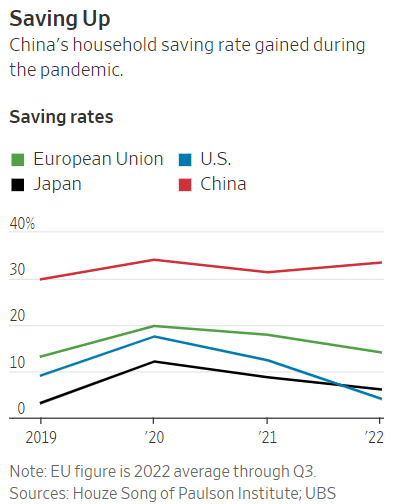
China’s household savings rate was 33% in 2022, 3pp above the pre-pandemic trend, and big industrial companies added $1.1 trillion in liquid assets on average each year, more than double the $467 billion annual increase in the five years before Covid. @WSJ

Will pandemic-era household savings power China's consumption recovery?

Core argument: China's household saving rate rose to a multiyear high of 33% in 2022 as families constrained by Covid lockdowns hoarded cash.

Chinese families, constrained by Covid lockdowns, hoarded cash and pushed up the country’s household saving rate to a multiyear high of 33% in 2022.  Economists from HSBC and Morgan Stanley say the end of China’s strict zero-Covid policies will at minimum fuel a strong recovery in services spending, lifting consumption growth to at least its prepandemic rate of around 8% a year. A large portion of new deposits accumulated by Chinese households last year was locked up in three-year to five-year deposit instruments, which can’t as easily be converted into spending as short-term deposits can, according to a study by research firm Rhodium Group.

Takeaways by Macro Roundup® AI

  1. China's household saving rate rose to a multiyear high of 33% in 2022 as families constrained by Covid lockdowns hoarded cash.
  2. Economists at HSBC and Morgan Stanley say the end of China's zero-Covid policies will at minimum drive a strong services spending recovery, lifting consumption growth to at least its prepandemic pace of around 8% a year.
  3. A study by research firm Rhodium Group finds a large portion of Chinese households' new deposits was locked into three-year to five-year instruments, which convert into spending less easily than short-term deposits.

China’s household savings rate was 33% in 2022, 3pp above the pre-pandemic trend, and big industrial companies added $1.1 trillion in liquid assets on average each year, more than double the $467 billion annual increase in the five years before Covid.

“…Chinese families, constrained by Covid lockdowns, hoarded cash and pushed up the country’s household saving rate to a multiyear high of 33% in 2022. Economists from HSBC and Morgan Stanley say the end of China’s strict zero-Covid policies will at minimum fuel a strong recovery in services spending, lifting consumption growth to at least its prepandemic rate of around 8% a year. A large portion of new deposits accumulated by Chinese households last year was locked up in three-year to five-year deposit instruments, which can’t as easily be converted into spending as short-term deposits can, according to a study by research firm Rhodium Group….”

Stella Yifan Xie, “Covid-Era Savings Are Crucial to China’s Economic Recovery,” Wall Street Journal, February 26, 2023, https://www.wsj.com/articles/covid-era-savings-are-crucial-to-chinas-economic-recovery-1ee3310b

Covid-Era Savings Are Crucial to China’s Economic Recovery

The strength of China’s economic rebound this year largely hinges on one uncertainty: whether families and large companies are willing to draw down the pile of cash they built up since the start of Covid-19.

Chinese families, constrained by Covid lockdowns, hoarded cash and pushed up the country’s household saving rate to a multiyear high of 33% in 2022, up 3 percentage points from the prepandemic trend in 2019, according to estimates by Goldman Sachs.

Large industrial companies and exporters also socked away money. From 2020 to 2022, big industrial companies, many state-owned, added $1.1 trillion in liquid assets on average each year, more than double the $467 billion annual increase in the five years before Covid hit, according to economists at China International Capital Corp., an investment bank.

In the U.S., excess savings—some from government stimulus—quickly coursed through the economy, but many experts wonder whether China will likewise have a big rebound in spending or investment this year.

Economists from HSBC and Morgan Stanley say the end of China’s strict zero-Covid policies will at minimum fuel a strong recovery in services spending, lifting consumption growth to at least its prepandemic rate of around 8% a year. Initial data from China’s recent Lunar New Year holiday suggest some Chinese consumers are eager to dine out and visit cinemas again.

Other economists feel more skeptical.

They argue that the savings buildup in China is more a reflection of battered confidence, which is unlikely to be reversed quickly as pains from the pandemic linger. Many Chinese consumers remain nervous because of a depressed housing market and an uncertain jobs picture, which could make them save more and spend less for longer.

“It is premature to conclude that excess savings accumulated by households will support revenge spending in a persistent way,” said David Wang, chief China economist at Credit Suisse.

A slow consumption rebound in China could reverberate globally, damping sales for such companies as Nike Inc., Starbucks Corp. and international auto makers, and resulting in lower-than-expected demand for such commodities as copper and nickel. Many businesses are counting on China, which is projected to account for a third of global growth this year as growth in the U.S. and Europe slows, according to the International Monetary Fund.

Swelling household savings helped push China’s current-account surplus to $417.5 billion last year, the highest level since 2008, underscoring just how entrenched the global trade imbalance has been even as the U.S. and other more-advanced economies attempt to reduce reliance on Chinese imports.

It isn’t clear exactly how big China’s savings pile is. Many economists, concerned about data quality in China, use different methods for their calculations.

Goldman Sachs says it believes Chinese families accumulated about three trillion yuan, equivalent to roughly $431 billion, in excess savings, or less than 3% of China’s gross domestic product, from 2020 to 2022. Economists from Nomura and UBS put the figures higher, at 6.1 trillion yuan and up to 4.6 trillion yuan, respectively, or about 5% and close to 4% of GDP in 2022.

While sizable, those figures are lower than in the U.S., where households put away $2.3 trillion in excess savings from 2020 through September 2021, or nearly 10% of GDP in 2021, according to a study published by the Federal Reserve.

A large portion of new deposits accumulated by Chinese households last year was locked up in three-year to five-year deposit instruments, which can’t as easily be converted into spending as short-term deposits can, according to a study by research firm Rhodium Group.

Given that China’s government refrained from handing out checks directly to households during the pandemic, it could take a while before people become more confident in China’s recovery and significantly scale back their saving, said Tao Wang, an economist at UBS.

More relevant to consumers’ spending appetite, economists say, are income growth and the job market, both of which are recovering slowly.

Zhou Changtian, who works at a state-owned publishing house in Shanghai, ended up saving more during the past three years as his family wasn’t able to travel abroad. Even though he isn’t deeply worried about job security, he isn’t keen on splurging, partly because of inflation fears as the economy reopens.

“It used to cost us 1,000 yuan [about $145] to stock up on meat in the fridge before Covid. Now we have to pay double,” said Mr. Zhou. “I definitely won’t go on a spending spree.”

Some companies are loosening their purse strings in anticipation of a strong economic recovery. Several industrial companies in China have announced big-ticket projects, including Ganfeng Lithium—one of the world’s largest refiners of strategic metal—which last month unveiled a 15 billion yuan ($2.2 billion) investment to build two battery plants in China.

But Larry Hu, chief China economist at Macquarie Group, is cautious about whether corporations have strong incentives to spend. He expects overall capital expenditure to stay flat compared with last year, in part because of uncertainty at export-oriented companies as overseas demand has weakened.

Another concern: Even though big companies were able to put away money by delaying investments during the pandemic, many smaller Chinese businesses, lacking deep pockets, had to spend savings to survive. Many are still on the ropes—or wiped out entirely.

Beijing restaurant operator Nathan Zhang said he hasn’t been able to repay food and wine suppliers at a bistro he owns, because it was forced to shut down or banned from offering dine-in services several times under Covid restrictions. Even though those restrictions have ended, Mr. Zhang estimates that he has lost about 10% to 20% of his regular clientele.

“While we still harbor hope that the worst is behind us, there are still too many uncertainties,” he said.

  • Business Cycle
  • China
  • GDP
    • Savings Glut/Trade Deficit

China’s Economy Is Looking At A New Wave Of Japanification

AI Summary. Citigroup identifies parallels between China's economy and Japan's bubble era: both sustained strong growth through infrastructure investment and export promotion, financed largely through indirect bank lending that authorities could direct toward favored sectors. Capital formation averaged 43% of Chinese GDP growth between 2010 and 2020, versus roughly 36% in Japan when its bubble burst.

Leo Lewis Financial Times
Date Posted:
February 27, 2023

A Citigroup analysis highlights parallels between the late ‘80s Japanese investment bubble and recent investment trends in China: capital formation as an outsized proportion of GDP and a development strategy reliant on large current account surpluses.

A Citigroup analysis highlights parallels between the late ‘80s Japanese investment bubble and recent investment trends in...

Does China's growth model resemble Japan's bubble-era economy?

Core argument: Capital formation averaged 43% of China's GDP growth between 2010 and 2020, according to the World Bank, above the roughly 36% share Japan recorded when its bubble burst in 1990, a level then considered very high.

Citigroup identifies several areas of similarity. Both countries entered extended phases of strong GDP growth via investment in infrastructure and the encouragement of exports. Between 2010 and 2020, capital formation represented an average 43% of Chinese GDP growth, according to the World Bank. When its bubble burst in 1990, Japan’s capital formation proportion was at roughly 36%, and considered very high. Japan and China also financed their growth in a similar way. Japan’s bubble era was fuelled by indirect financing provided by commercial banks, which were nudged by the authorities into funnelling soft loans towards favoured industrial sectors. Similarly, says Citigroup, China has developed a financial system mainly dependent on indirect financing. As well as the tools available to the People’s Bank of China, the government can direct the lending activities of commercial banks via a series of mechanisms.

Takeaways by Macro Roundup® AI

  1. Capital formation averaged 43% of China's GDP growth between 2010 and 2020, according to the World Bank, above the roughly 36% share Japan recorded when its bubble burst in 1990, a level then considered very high.
  2. Citigroup identifies similarities between China and Japan, noting both entered extended phases of strong GDP growth driven by infrastructure investment and the encouragement of exports.
  3. Japan's bubble era was fuelled by indirect financing from commercial banks nudged by authorities into soft loans for favoured industrial sectors, and Citigroup says China likewise depends mainly on indirect financing, with the government able to direct commercial bank lending.
  • China
  • GDP
    • Business Cycle
    • Savings Glut/Trade Deficit

Tuesday, February 28, 2023

The Role of Immigration in U.S. Labor Market Tightness

AI Summary. State-level analysis estimates that a slowdown in immigration to the United States modestly tightened local labor markets, raising the ratio of job vacancies to unemployed workers by 5.5 percentage points. A subsequent rebound in immigration helped close the shortfall in foreign-born labor, contributing a one-point reduction in that ratio.

Evgeniya Duzhak Federal Reserve Bank of San Francisco
Date Posted:
February 28, 2023
Is Database:
Database

A strong rebound in immigration in 2022 helped offset tight U.S. labor markets, contributing to a 6-percentage point reduction in the ratio of job vacancies to unemployed workers. @sffed

Does slower immigration tighten local labor markets?

Core argument: State-level analysis finds the slowdown in U.S. immigration raised the ratio of job vacancies to unemployed workers by 5.5 percentage points between 2017 and 2021, tightening local labor markets modestly.

Immigration flows into the United States slowed significantly following immigration policy changes from 2017 to 2020 and the onset of the COVID-19 pandemic. Analysis of state-level data shows that this migration slowdown tightened local labor markets modestly, raising the ratio of job vacancies to unemployed workers (V-U) 5.5 percentage points between 2017 and 2021. More recent data show immigration has rebounded strongly, helping to close the shortfall in foreign-born labor and ease tight labor markets. Data for 2022 show a strong rebound in immigration that has helped offset tight U.S. labor markets by contributing a point reduction in the V–U ratio.

Takeaways by Macro Roundup® AI

  1. State-level analysis finds the slowdown in U.S. immigration raised the ratio of job vacancies to unemployed workers by 5.5 percentage points between 2017 and 2021, tightening local labor markets modestly.
  2. Immigration flows into the United States slowed significantly following immigration policy changes from 2017 to 2020 and the onset of the COVID-19 pandemic.
  3. Data for 2022 show a rebound in immigration that helped close the shortfall in foreign-born labor, contributing a 1-point reduction in the vacancies-to-unemployed ratio.
  • Immigration

Americans Don’t Save Much, But Their Companies Do

AI Summary. US household saving rates are low, but business saving has risen over recent decades, with undistributed corporate profits now a bit above $1.2tn and gross US saving running between 17% and 18% of GDP. This asymmetric distribution of the saving burden can create wealth distribution problems over time.

Tyler Cowen Bloomberg
Date Posted:
February 28, 2023

.@tylercowen notes that America’s low personal savings rate of 4.7% in January 2023 is offset by higher corporate savings which results in a gross savings rate of 17-18% of GDP.

Does business saving offset low US household saving?

Core argument: Undistributed US business profits, per the Federal Reserve's series, stand a bit above $1.2 trillion, having risen significantly from the 1970s and taken off around 2000 with a dip during the financial crisis.

At the household level, Americans have long been poor savers. Are such low savings rates unsustainable for an advanced economy? Not in view of America’s business saving. Looking at the US Federal Reserve’s series on undistributed business profits, it starts to rise significantly in the 1970s, and takes off around 2000 (with a dip for the financial crisis), and currently stands a bit above $1.2 trillion. There are other ways to measure business savings rates, but generally they show a significant upward move over the last few decades. On net, gross US savings rates are hovering between 17% and 18% of GDP. This asymmetric distribution of the savings burden can lead to wealth distribution problems over time.

Takeaways by Macro Roundup® AI

  1. Undistributed US business profits, per the Federal Reserve's series, stand a bit above $1.2 trillion, having risen significantly from the 1970s and taken off around 2000 with a dip during the financial crisis.
  2. Gross US savings rates hover between 17% and 18% of GDP, so low household saving need not make America's overall savings position unsustainable given business saving.
  3. The asymmetric distribution of the savings burden between US households and companies can lead to wealth distribution problems over time.
  • Investment
  • Fiscal Policy
    • Fiscal Deficits
  • GDP
    • Financial Markets
  • Productivity

BoJ Finally Corners 10-Year JGB Market

AI Summary. The Bank of Japan owns more than 100% of all current 10-year Japanese government bonds, including almost 140% of the most recent issue, a result of buying bonds, lending them out to preserve market supply, and then buying them back after short sellers sell them.

Robin Wigglesworth Financial Times
Date Posted:
February 28, 2023

.@RobinWigg notes a Deutsche Bank report that the Bank of Japan may have purchased “more than 100 per cent of some Japanese government bonds” after accounting for bonds the bank lends to short sellers and subsequently repurchases.

How can a central bank own over 100% of a bond issue?

Core argument: The Bank of Japan owns more than 100% of all on-the-run 10-year Japanese government bonds, and almost 140% of the most recent issue, according to Oxford Economics' Norihiro Yamaguchi.

Deutsche Bank’s tidbit that the BoJ “may” have bought more than 100 per cent of some Japanese government bonds, as it buys the JGBs, lends them out again to ensure the market still has some supply, short sellers borrow it and dump them in the market, only for the BoJ to buy it once more. Here is a killer chart from Oxford Economics’ Norihiro Yamaguchi that puts more flesh on the bone. After buying a record ¥20tn of JBGs last month, the BoJ now owns more than 100 per cent of all on-the-run 10-year Japanese government bonds. In fact, it owns almost 140 per cent of the most recent issue.

Takeaways by Macro Roundup® AI

  1. The Bank of Japan owns more than 100% of all on-the-run 10-year Japanese government bonds, and almost 140% of the most recent issue, according to Oxford Economics' Norihiro Yamaguchi.
  2. The Bank of Japan bought a record ¥20tn of Japanese government bonds in a single month, according to Oxford Economics.
  3. Deutsche Bank describes a loop in which the Bank of Japan buys JGBs, lends them out again to preserve market supply, short sellers borrow and dump them, and the BoJ buys them once more.
  • Financial Markets
  • GDP

China’s Hidden Tech Revolution

AI Summary. The article argues that the United States should treat mass production as equal in importance to invention and research, rather than dismissing manufacturing as a commoditized activity best done overseas. Regaining leadership in emerging technologies requires treating manufacturing as integral to technological advancement.

Dan Wang Foreign Affairs
Date Posted:
February 28, 2023

.@danwwang argues that US technological competitiveness depends on mass production, “an activity that depends on the kinds of deep process knowledge that can only come from the better training and integration of workers, engineers, and scientists.”

Is mass production as important as invention for technological leadership?

Core argument: Regaining a U.S. lead in emerging technologies requires treating manufacturing as an integral part of technological advancement rather than a sideshow to invention and R&D, the authors argue.

To get better at scaling up, the United States will also have to learn to think differently about the value of manufacturing work. Policymakers must resist the urge to scorn manufacturing as a mere “commoditized activity” that can be done overseas. Instead, the mass production of new technologies needs to be seen as equal in importance to the innovations themselves. For the United States to regain its lead in emerging technologies, it will have to treat manufacturing as an integral part of technological advancement, not a mere sideshow to the more thrilling acts of invention and R & D.

Takeaways by Macro Roundup® AI

  1. Regaining a U.S. lead in emerging technologies requires treating manufacturing as an integral part of technological advancement rather than a sideshow to invention and R&D, the authors argue.
  2. U.S. policymakers must resist scorning manufacturing as a "commoditized activity" suitable for offshoring, and instead value mass production of new technologies as equal in importance to the innovations themselves, the authors argue.
  3. Getting better at scaling up will require the United States to think differently about the value of manufacturing work, the authors argue.
  • Investment
  • Productivity
    • Innovation/Research
    • Institutional Capabilities

America Is Trying to Electrify. There Aren’t Enough Electricians

AI Summary. The U.S. Bureau of Labor Statistics projects the country's more than 700,000 electricians will grow about 7% over the next decade, against a 5% average for all occupations. Electricians report being booked months out and struggling to hire, and many are raising wages and prices as federal climate incentives worth several hundred billion dollars take effect.

Amrith Ramkumar Wall Street Journal
Date Posted:
February 28, 2023

A shortage of electricians is likely to be a headwind to the energy transition. 30% of union electricians are btw 50-70 years old and close to retirement. The average annual electrician salary rose from $50k to $60k btw 2018 and 2022. @WSJ

A shortage of electricians is likely to be a headwind to the energy transition.  30% of union electricians are btw 50-70...

Are there enough electricians to meet electrification demand?

Core argument: The Bureau of Labor Statistics expects the U.S. total of more than 700,000 electricians to grow about 7% over the next decade, slightly faster than the 5% nationwide average.

The current total of more than 700,000 electricians in the U.S. is expected to grow about 7% over the next decade, slightly faster than the nationwide average of 5%, according to the Bureau of Labor Statistics. The climate law will put several hundred billion dollars’ worth of incentives into the economy designed to accelerate the energy transition and boost clean-energy supply chains in the U.S. Electricians say they are booked several months out and struggling to find enough workers to keep up with demand. Many are raising wages and prices and worried that they won’t be able to keep up as government climate incentives kick in. “I’m tired of telling people I can’t help them,” said Brian LaMorte, co-owner of LaMorte Electric Heating and Cooling in Ithaca, N.Y., which does residential heat-pump installations and electric-service upgrades.

Takeaways by Macro Roundup® AI

  1. The Bureau of Labor Statistics expects the U.S. total of more than 700,000 electricians to grow about 7% over the next decade, slightly faster than the 5% nationwide average.
  2. Electricians report being booked several months out and struggling to find enough workers, and many are raising wages and prices to cope with demand.
  3. The climate law will put several hundred billion dollars' worth of incentives into the economy to accelerate the energy transition and boost U.S. clean-energy supply chains, and electricians worry they won't keep up as those incentives kick in.
  • Workforce Reorganization
  • Productivity
  • Workforce

Apple Suppliers Are Racing to Exit China, AirPods Maker Says

AI Summary. Apple's Chinese suppliers are likely to shift production out of China faster than many observers expect to preempt US-China tensions, according to AirPods maker GoerTek, which is investing an initial $280m in a Vietnam plant and weighing an India expansion. Bloomberg Intelligence estimates moving 10% of Apple's capacity could take eight years.

Nguyen Xuan Quynh and John Boudreau Bloomberg
Date Posted:
February 28, 2023

Apple’s suppliers are likely to move capacity out of China faster than Bloomberg Intelligence currently projects, according to a senior executive at GoerTek who manufactures AirPods for Apple. @markets

Apple’s suppliers are likely to move capacity out of China faster than Bloomberg Intelligence currently projects, according...

Are Apple's Chinese suppliers moving production abroad faster than expected?

Core argument: GoerTek, the maker of Apple's AirPods, is investing an initial $280 million in a new Vietnam plant while weighing an India expansion, according to Deputy Chairman Kazuyoshi Yoshinaga.

Apple Inc.’s Chinese suppliers are likely to move capacity out of the country far faster than many observers anticipate to preempt fallout from escalating Beijing-Washington tensions, according to one of the US company’s most important partners. AirPods maker GoerTek is one of the many manufacturers exploring locations beyond its native China. It’s investing an initial $280 million in a new Vietnam plant while considering an India expansion, Deputy Chairman Kazuyoshi Yoshinaga said in an interview. Behind the scenes, 9 out of 10 of Apple’s most important suppliers may be preparing large-scale moves to countries like India, which is dangling incentives to drive Narendra Modi’s Make in India initiative. Bloomberg Intelligence estimates it could take eight years to move just 10% of Apple’s capacity outside of China. The GoerTek executive argues it’ll be far quicker.

Takeaways by Macro Roundup® AI

  1. GoerTek, the maker of Apple's AirPods, is investing an initial $280 million in a new Vietnam plant while weighing an India expansion, according to Deputy Chairman Kazuyoshi Yoshinaga.
  2. Nine out of 10 of Apple's most important suppliers may be preparing large-scale moves to countries such as India, which is offering incentives under Narendra Modi's Make in India initiative.
  3. Bloomberg Intelligence estimates that moving just 10% of Apple's capacity out of China could take eight years, while GoerTek's Kazuyoshi Yoshinaga argues the shift will be far quicker.
  • Trade (not deficits)
  • China
  • GDP

As China Reopens, Flight of Wealthy Chinese to Singapore Set to Accelerate

AI Summary. Research firm New World Wealth estimates that about 10,800 wealthy Chinese left China in a single year, with Chinese nationals typically accounting for 8%–10% of global millionaire migration. The firm projects roughly 125,000 people with net assets above $1m will relocate, exceeding the prior record of 110,000.

Jason Douglas, Keith Zhai and Stella Yifan Xie Wall Street Journal
Date Posted:
February 28, 2023

.@WSJ reports an expected increase this year over the 10,800 wealthy Chinese who left the country in 2022. A recent expatriate noted, “We thought if we don’t leave sooner, we may never be able to.”

.@WSJ reports an expected increase this year over the 10,800 wealthy Chinese who left the country in 2022. A recent...

Are wealthy Chinese leaving the country in record numbers?

Core argument: New World Wealth estimates around 10,800 wealthy Chinese left China in 2022, with Chinese nationals typically accounting for 8%–10% of global millionaire migration.

Around 10,800 wealthy Chinese left the country in 2022, according to estimates from New World Wealth, a research firm that tracks the movements and spending habits of the world’s high-net-worth citizens. The company expects around 125,000 people with net assets of more than $1 million to move this year, exceeding the 2019 record of 110,000. Chinese nationals usually account for 8% to 10% of the total. New World Wealth tracks the behavior of around 150,000 individuals in a database to derive its estimates for total migration.

Takeaways by Macro Roundup® AI

  1. New World Wealth estimates around 10,800 wealthy Chinese left China in 2022, with Chinese nationals typically accounting for 8%–10% of global millionaire migration.
  2. New World Wealth expects about 125,000 people with net assets above $1 million to relocate this year, exceeding the 2019 record of 110,000.
  3. New World Wealth derives its migration estimates by tracking the movements and spending habits of around 150,000 high-net-worth individuals in its database.
  • China
  • Workforce
    • Immigration

Covid-Era Savings Are Crucial to China's Economic Recovery

AI Summary. China's household savings rate reached 33%, 3 percentage points above the pre-pandemic trend, while large industrial companies added $1.1tn in liquid assets annually, more than double the prior $467bn pace. Economists at HSBC and Morgan Stanley expect the end of zero-Covid restrictions to lift services spending, though much of the savings sits in long-term deposits.

Stella Yifan Xie Wall Street Journal
Date Posted:
February 28, 2023
Is Database:
Database

China’s household savings rate surged to 33% in 2022, 3pp above pre-pandemic trend, as families hoarded cash during Covid lockdowns. Big industrial companies added $1.1T in liquid assets annually from 2020-2022, more than double pre-Covid levels.

Will China's elevated household and corporate savings fuel a consumption rebound?

Core argument: China's household savings rate rose to 33% in 2022, 3 percentage points above the pre-pandemic trend, as families hoarded cash during Covid lockdowns.

China's household savings rate surged to 33% in 2022, 3pp above the pre-pandemic trend, as families hoarded cash during Covid lockdowns. This elevated savings level, alongside big industrial companies adding $1.1tn in liquid assets annually from 2020-2022—more than double the $467bn annual increase pre-Covid—positions China for a potential economic rebound. Economists from HSBC and Morgan Stanley anticipate that the end of zero-Covid policies will boost services spending, potentially lifting consumption growth to its pre-pandemic rate of ~8% annually. However, the conversion of these savings into spending is uncertain, as a significant portion is tied up in long-term deposits. The global impact of China's consumption patterns is significant, with many businesses relying on China for growth amid slowing economies in the U.S. and Europe. Despite the potential for recovery, concerns about consumer confidence and the job market persist, influencing the pace at which savings might translate into economic activity.

Takeaways by Macro Roundup® AI

  1. China's household savings rate rose to 33% in 2022, 3 percentage points above the pre-pandemic trend, as families hoarded cash during Covid lockdowns.
  2. Large Chinese industrial companies added $1.1tn in liquid assets annually during 2020–2022, more than double the $467bn annual increase before Covid.
  3. Economists at HSBC and Morgan Stanley expect the end of zero-Covid policies to boost services spending and lift consumption growth toward its pre-pandemic pace of about 8% a year, though much of the savings sits in long-term deposits.

China's household savings rate was 33% in 2022, 3pp above the pre-pandemic trend, and big industrial companies added $1.1 trillion in liquid assets on average each year, more than double the $467 billion annual increase in the five years before Covid.

“…Chinese families, constrained by Covid lockdowns, hoarded cash and pushed up the country’s household saving rate to a multiyear high of 33% in 2022. Economists from HSBC and Morgan Stanley say the end of China’s strict zero-Covid policies will at minimum fuel a strong recovery in services spending, lifting consumption growth to at least its prepandemic rate of around 8% a year. A large portion of new deposits accumulated by Chinese households last year was locked up in three-year to five-year deposit instruments, which can’t as easily be converted into spending as short-term deposits can, according to a study by research firm Rhodium Group….”

Stella Yifan Xie, "Covid-Era Savings Are Crucial to China’s Economic Recovery,"Wall Street Journal, February 26, 2023, https://www.wsj.com/articles/covid-era-savings-are-crucial-to-chinas-economic-recovery-1ee3310b

Covid-Era Savings Are Crucial to China’s Economic Recovery

The strength of China’s economic rebound this year largely hinges on one uncertainty: whether families and large companies are willing to draw down the pile of cash they built up since the start of Covid-19.

Chinese families, constrained by Covid lockdowns, hoarded cash and pushed up the country’s household saving rate to a multiyear high of 33% in 2022, up 3 percentage points from the prepandemic trend in 2019, according to estimates by Goldman Sachs.

Large industrial companies and exporters also socked away money. From 2020 to 2022, big industrial companies, many state-owned, added $1.1 trillion in liquid assets on average each year, more than double the $467 billion annual increase in the five years before Covid hit, according to economists at China International Capital Corp., an investment bank.

In the U.S., excess savings—some from government stimulus—quickly coursed through the economy, but many experts wonder whether China will likewise have a big rebound in spending or investment this year.

Economists from HSBC and Morgan Stanley say the end of China’s strict zero-Covid policies will at minimum fuel a strong recovery in services spending, lifting consumption growth to at least its prepandemic rate of around 8% a year. Initial data from China’s recent Lunar New Year holiday suggest some Chinese consumers are eager to dine out and visit cinemas again.

Other economists feel more skeptical.

They argue that the savings buildup in China is more a reflection of battered confidence, which is unlikely to be reversed quickly as pains from the pandemic linger. Many Chinese consumers remain nervous because of a depressed housing market and an uncertain jobs picture, which could make them save more and spend less for longer.

Covid-Era Savings Are Crucial to China's Economic Recovery: Extended Excerpt Image 1


“It is premature to conclude that excess savings accumulated by households will support revenge spending in a persistent way,” said David Wang, chief China economist at Credit Suisse.

A slow consumption rebound in China could reverberate globally, damping sales for such companies as Nike Inc., Starbucks Corp. and international auto makers, and resulting in lower-than-expected demand for such commodities as copper and nickel. Many businesses are counting on China, which is projected to account for a third of global growth this year as growth in the U.S. and Europe slows, according to the International Monetary Fund.

Swelling household savings helped push China’s current-account surplus to $417.5 billion last year, the highest level since 2008, underscoring just how entrenched the global trade imbalance has been even as the U.S. and other more-advanced economies attempt to reduce reliance on Chinese imports.

It isn’t clear exactly how big China’s savings pile is. Many economists, concerned about data quality in China, use different methods for their calculations.

Goldman Sachs says it believes Chinese families accumulated about three trillion yuan, equivalent to roughly $431 billion, in excess savings, or less than 3% of China’s gross domestic product, from 2020 to 2022. Economists from Nomura and UBS put the figures higher, at 6.1 trillion yuan and up to 4.6 trillion yuan, respectively, or about 5% and close to 4% of GDP in 2022.

While sizable, those figures are lower than in the U.S., where households put away $2.3 trillion in excess savings from 2020 through September 2021, or nearly 10% of GDP in 2021, according to a study published by the Federal Reserve.

A large portion of new deposits accumulated by Chinese households last year was locked up in three-year to five-year deposit instruments, which can’t as easily be converted into spending as short-term deposits can, according to a study by research firm Rhodium Group.

Given that China’s government refrained from handing out checks directly to households during the pandemic, it could take a while before people become more confident in China’s recovery and significantly scale back their saving, said Tao Wang, an economist at UBS.

More relevant to consumers’ spending appetite, economists say, are income growth and the job market, both of which are recovering slowly.

Zhou Changtian, who works at a state-owned publishing house in Shanghai, ended up saving more during the past three years as his family wasn’t able to travel abroad. Even though he isn’t deeply worried about job security, he isn’t keen on splurging, partly because of inflation fears as the economy reopens.

“It used to cost us 1,000 yuan to stock up on meat in the fridge before Covid. Now we have to pay double,” said Mr. Zhou. “I definitely won’t go on a spending spree.”

Some companies are loosening their purse strings in anticipation of a strong economic recovery. Several industrial companies in China have announced big-ticket projects, including Ganfeng Lithium—one of the world’s largest refiners of strategic metal—which last month unveiled a 15 billion yuan ($2.2 billion) investment to build two battery plants in China.

But Larry Hu, chief China economist at Macquarie Group, is cautious about whether corporations have strong incentives to spend. He expects overall capital expenditure to stay flat compared with last year, in part because of uncertainty at export-oriented companies as overseas demand has weakened.

Another concern: Even though big companies were able to put away money by delaying investments during the pandemic, many smaller Chinese businesses, lacking deep pockets, had to spend savings to survive. Many are still on the ropes—or wiped out entirely.

Beijing restaurant operator Nathan Zhang said he hasn’t been able to repay food and wine suppliers at a bistro he owns, because it was forced to shut down or banned from offering dine-in services several times under Covid restrictions. Even though those restrictions have ended, Mr. Zhang estimates that he has lost about 10% to 20% of his regular clientele.

“While we still harbor hope that the worst is behind us, there are still too many uncertainties,” he said.

  • Business Cycle
  • China
  • GDP
    • Savings Glut/Trade Deficit


Loading More Posts

End of content

No more pages to load

© Copyright 2026 Coherent Research Institute · All Rights Reserved · Privacy · Terms