


Will slowing wage growth be enough to bring inflation down?
Core argument: Twelve-month employment cost index growth peaked at 5.4% in June 2022 and eased to 5.1% as of September.
Figure 1 displays the growth rate of the employment cost index over the past 20 years along with a projection over the next two that is a bit higher than that of professional forecasters. Twelve-month ECI growth peaked at 5.4% in June 2022 and declined to 5.1% as of September. In the projection, ECI rises at an annualized pace of 5% from September 2022 to March 2023, 4.5% from March to December 2023, and 4% in 2024. This projection is consistent with only a modest cooling in the labor market and an unemployment rate still somewhat lower than its equilibrium rate. Further reductions in inflation beyond 2024 would require ECI growth to slow well below a 4% pace.


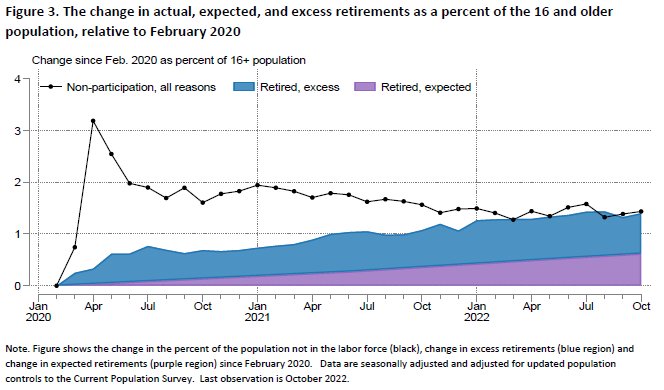


Brandon Adams Comment: “This is a great paper. I think the labor force participation rate could converge toward its pre-pandemic trend line faster than envisioned in this paper. The paper ignores asset markets altogether, and it seems clear to me that rapidly inflating retirement accounts in 2021 was a big part of this story. Towards the tail end of the time period covered in this paper, retirees met the unwelcome duo of rapidly decreasing asset prices and rapidly increasing consumer prices. This might or might not bring people in their 60s or 70s out of retirement, but it will almost surely slow the exit rate of those aged 40-60, and it might also bring back into the labor force some people in that age range who are currently sitting out.”