


Why are fully self-driving cars still decades away despite massive investment?
Core argument: More than $80bn has been invested in autonomous driving technology, yet experts argue fully self-driving cars remain decades away because of unresolved AI challenges.
Despite over $80bn invested in autonomous driving technology, fully self-driving cars remain decades away due to significant AI challenges. Experts highlight that current machine-learning systems excel at pattern-matching but struggle with knowledge-based reasoning, crucial for navigating complex, real-world scenarios. Attempts to compensate with ultra-detailed maps are insufficient, as they aren't updated frequently enough to handle unexpected situations like unmapped construction sites. While small, low-speed shuttles in well-mapped areas may reduce uncertainty to acceptable levels, achieving widespread autonomy requires breakthroughs in AI or a complete redesign of urban infrastructure. Consequently, the promise of steering-wheel-free cars remains elusive, with current offerings limited to enhanced driver-assist systems. This underscores the gap between investment expectations and technological reality, suggesting that the path to full autonomy may involve integrating AI with other technologies and systems engineering approaches.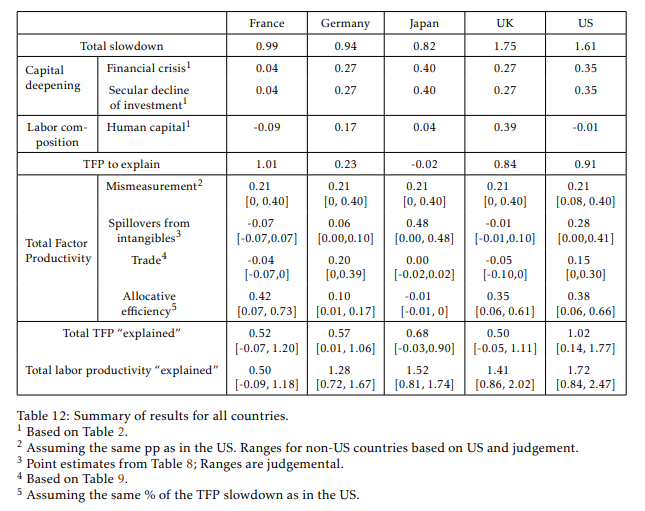


Ed Comment:Ben would need to explain this to us for me to feel confident in my understanding. My own view is that, aside from the financial crisis, there are no constraints and savings and investment. So the slowdown is entirely structural. I believe (in approximate order of importance) and off the top of my head:- The 1940s to 60s were uniquely productive and therefore a misleading standard of comparison
- And they started for a low base.
- Manufacturing productivity gains have exceeded the growth in the demand for manufactured goods, hollowing out manufacturing employment.
- $3 an hour offshore labor has exacerbated the demise of manufacturing.
- Services have inherently slower productivity growth for a variety of known and unknown reasons.
- There are less economies of scale.
- The operations are more decentralized than manufacturing and therefore harder to manage.
- The tasks are less specialized.
- There are no machines to pace the work.
- The need for more human interaction makes the tasks harder.
- Talented people are increasing working for each other.
- It’s more profitable/rewarding
- Hard-to-manage low-skilled services exacerbates the tradeoff.
- Workers who can’t supervise themselves are increasingly pushed into jobs suffering from Baumol’ cost disease.
- There is no reason why the value per capita produced by (a fixed number of ) innovators (per capita) should be growing at the same proportional amount to GDP per capita. I suspect it should be declining all other things being equal. A person can only do/create so much. And economy that twice as large per capita doesn’t make innovators twice as productive.
- Larger world markets make improvements more profitable, so effort can be profitably diverted to smaller improvements.
- Talent is constrained.
- Innovation requires more than just scientific researchers. Talent added to one task in the chain of tasks, reduces talent in the other tasks in the chain.
- The share of talented people willing to get trained and serve customers has largely been maxed out.
- The richer we get the more it costs to get people to do it.
- The lib-tard brainwash people into not doing it.
- Education isn’t very effective, at least as it is currently administered.
- We are in a j-curve lull in the exogenously give set of unfilled niches. AI, quantum computing, fusion, and cancer cures have all proven harder than expected.
- Healthcare innovation reduces productivity by extending lives unproductivity.
- Inflation is mismeasured (for political reasons).
- To a lesser extent, so is the value of innovation.
- Government, regulation, and redistribution are growing and slow productivity growth.
- So do environmental and other similar concerns chiefly demands for diversity with double standards over meritocracy.
- The Mideast wars were more expensive than people realize.
- The share of dumb people is growing faster than smart people.
- and 1995 to 2005 was a blimp up in the US because of the success we enjoyed creating the first wave of commercializing the internet and using the information to make decisions more effectively. (i.e., we are now in the lull of the j-curve).