Edward Conard

Top Ten New York Times Bestselling Author

  • “…a very valuable contribution.” - Larry Summers, former Secretary of the Treasury and director of the National Economic Council, president emeritus, Harvard University
  • “…reminds us that inequality sends a signal of what society lacks most, in America’s case, entrepreneurship and risk taking.” - Lawrence Lindsey, CEO, The Lindsey Group, former Director of the National Economic Council
  • “…a fresh argument for the productive value of inequality.” - David Autor, Professor of Economics, Massachusetts Institute of Technology
  • “…a must-read for serious students of economic policy.” - Glenn Hubbard, Dean, Columbia Business School, and former Chairman of the Council of Economic Advisers
  • “Unintended Consequences provides a provocative interpretation of the causes of the global financial crisis and the policies needed to return to rapid growth. Whether you agree or not, this analysis is well worth reading.” - Nouriel Roubini, New York University; Chairman, Roubini Global Economics
  • “…serious thinking for serious thinkers. …a thought-provoking blueprint for growing middle- and working-class incomes.” - Mitt Romney, former Governor of Massachusetts
  • “Unintended Consequences represents the most cogent and persuasive analysis of the Financial Crisis to date.” - Andrei Shleifer, 1999 John Bates Clark Medal Winner
  • “Unintended Consequences offers deep and well-argued analyses on almost every issue.” - The New York Times
  • “…a must-read for serious students of economic policy.” - Glenn Hubbard, Dean, Columbia Business School, and former Chairman of the Council of Economic Advisers
  • “…a comprehensive explanation of the modern economy.” - Julian Robertson, Founder, Tiger Management
  • “…challenges misconceptions that distort our economic debates.” - Arthur Brooks, President of the American Enterprise Institute
  • “There are an amazing number of good ideas and interesting points made in Unintended Consequences. The thinking underlying it, and the obvious depth of understanding of the author, are very impressive.” - Steven Levitt, coauthor of Freakonomics; 2004 John Bates Clark Medal
Upside of Inequality Oxford Unintended Consequences
Buy the Books
  • Macro Roundup
  • About Roundup
  • About Ed Conard
  • Highlights
  • Topics
  • Subscribe
Edward Conard
  • twitter
  • facebook
  • linkedin
  • youtube

America Spends 25 Percent More per Capita on Social Welfare than Any Other Country

Despite popular misconceptions, Organisation for Economic Cooperation and Development (OECD) data confirms America spends more on social welfare than any other country—$13,500 per capita in 2009. This is nearly 25 percent more per capita than the second largest spender, France, and 35 percent more than Germany, Sweden, and other high-spending Scandinavian countries.
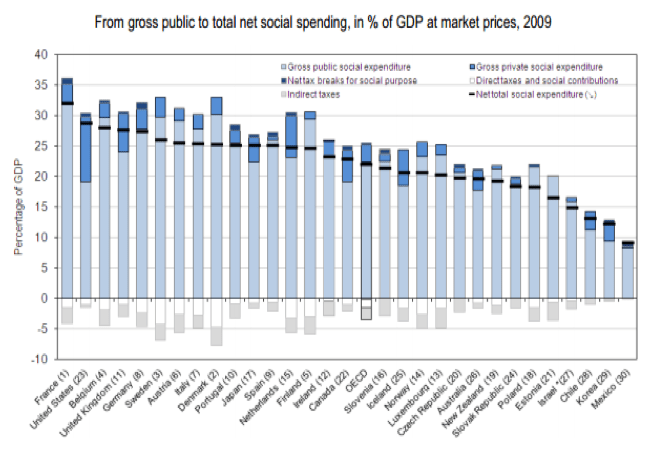
UntitledSeveral factors obscure this truth. Europe taxes benefits more heavily, whereas benefits are often tax-exempt in the United States. The private sector finances a much greater share of social spending in America, particularly healthcare. While France spends more than America as a share of GDP—32 vs. 29 percent—the much larger U.S. GDP per capita—$47,000 vs. $34,000, $36,000 and $38,000 in France, Germany, and Sweden respectively—yields much greater spending per capita.

The current OECD findings are similar to its 2007 findings—the year prior to the financial crisis—and to a 2003 study that contributed to the OECD’s methodology. In both previous studies, the U.S. spent more per capita than other countries and a similar amount per capita before the crisis in 2007 as it did in 2009.

Share this:

  • Share on X (Opens in new window) X
  • Share on Facebook (Opens in new window) Facebook
  • Share on LinkedIn (Opens in new window) LinkedIn
  • Print (Opens in new window) Print
  • Email a link to a friend (Opens in new window) Email
© Copyright 2026 Coherent Research Institute · All Rights Reserved · Privacy · Terms